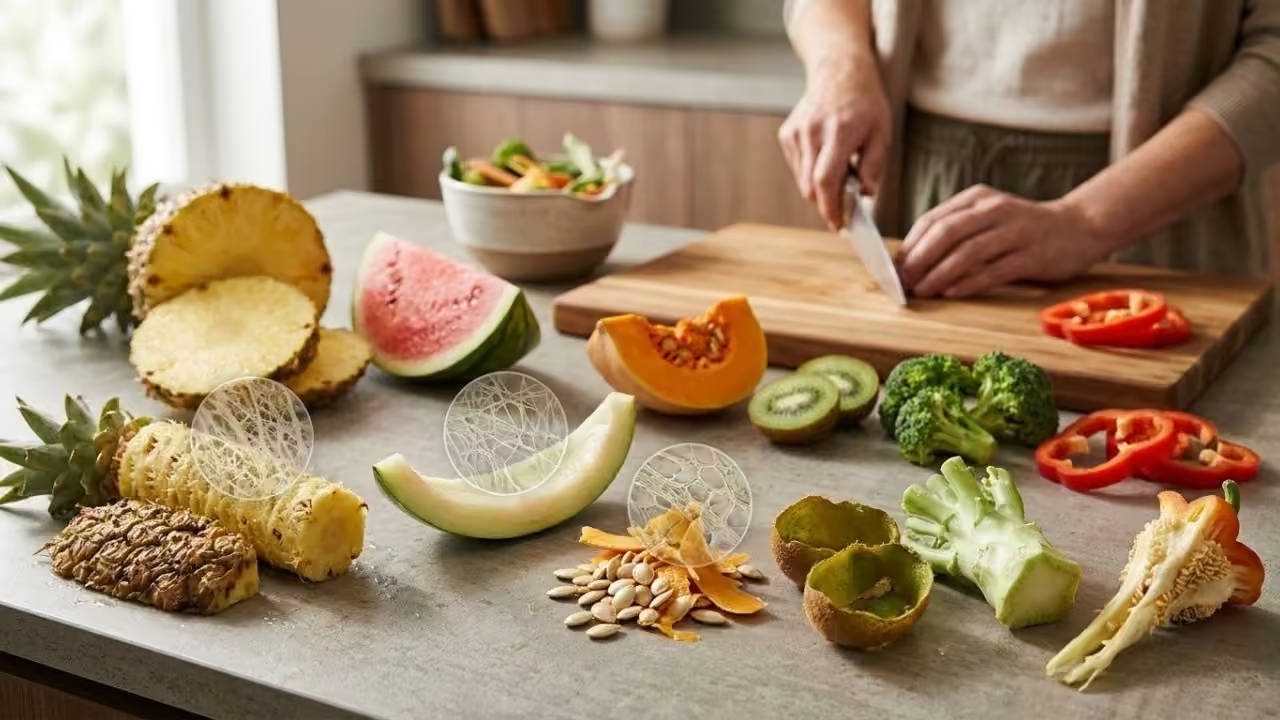
Peels, stalks, seeds and cores routinely tossed into kitchen bins may contain far more dietary fiber than the parts of fruits and vegetables people usually eat, according to new research.
Scientists from King’s College London analyzed 12 commonly consumed types of fresh produce and compared the fiber content of conventionally eaten portions with edible parts usually discarded during food preparation.

The study published in the International Journal of Food Sciences and Nutrition found that in 10 of the 12 foods tested, the discarded “root-to-tip” components contained more dietary fiber per 100 grams than the portions normally consumed.
Some differences were striking. Pineapple skin and core contained around 453.7% more fiber by weight than pineapple flesh, while watermelon rind contained around 425% more than the familiar red portion.
The findings suggest that making better use of edible plant parts could potentially increase fiber intake while reducing food waste.

But the researchers are not suggesting people should simply start chewing pineapple skin or large quantities of vegetable scraps. The study instead highlights opportunities to incorporate suitable edible parts into recipes and food products in practical ways.
Table of Contents
Researchers Tested 12 Common Fruits and Vegetables
The research team examined raw produce commonly used in UK food-service settings.
The foods included:
- beetroot;
- bell pepper;
- broccoli;
- butternut squash;
- cauliflower;
- celeriac;
- curly kale;
- fennel;
- kiwi fruit;
- leek;
- pineapple; and
- watermelon.
For each item, researchers separated the portion that people typically eat from edible material commonly removed during preparation.
They then measured total dietary fiber in both portions.
| Key finding | Result |
|---|---|
| Fruits and vegetables analyzed | 12 |
| Foods with more fiber in discarded portions | 10 of 12 |
| Lowest fiber in root-to-tip portion | 2.10 g/100 g |
| Highest fiber in root-to-tip portion | 9.25 g/100 g |
| Largest relative difference | Pineapple skin and core |
| Root-to-tip share of produce weight | Around 25%–48% |
The results show that a substantial proportion of the plant material people buy may be discarded despite containing significant amounts of fiber.
Pineapple Showed the Biggest Fiber Difference
Pineapple produced one of the study’s most striking results.
The skin and core contained approximately 453.7% more dietary fiber by weight than the flesh normally eaten.
This does not mean researchers recommend eating raw pineapple skin directly.
Pineapple skin is tough, difficult to chew and may contain compounds that make direct consumption impractical.
Instead, the finding demonstrates how nutritionally concentrated some discarded plant components can be.
Processing techniques such as blending, cooking, drying or using the material as an ingredient could potentially make some of these components more practical to consume.
Watermelon Rind Was Much Richer in Fiber Than the Flesh
Watermelon showed a similar pattern.
The rind contained approximately 2.10 grams of dietary fiber per 100 grams, substantially more than the water-rich red flesh.
Researchers calculated that watermelon rind contained roughly 425% more fiber by weight than the portion usually eaten.
The rind is edible and is already used in some cuisines through pickling, cooking and other preparation methods.
This makes watermelon an obvious example of how food considered “waste” in one setting may be treated as an ingredient in another.
Butternut Squash Skin and Seeds Had the Highest Fiber Level
The most fiber-dense discarded material tested came from butternut squash.
Its skin, seeds and inner material contained approximately 9.25 grams of fiber per 100 grams.
That was the highest concentration measured among the root-to-tip portions analyzed.
The King’s College London researchers noted that this does not mean consumers need to eat 100 grams of squash skin and seeds.
Instead, retaining or incorporating smaller amounts during normal food preparation could potentially increase the overall fiber content of meals.
Not Every Discarded Part Was More Fiber-Rich
The pattern was strong but not universal.
Broccoli was one of the exceptions.
Researchers found that broccoli stalks contained around 28.4% less fiber by weight than the florets people usually eat.
Fennel was another food where the discarded portions did not outperform the commonly eaten section.
This is important because the findings should not be interpreted as proof that every peel, stalk, seed or core is nutritionally superior.
The results varied considerably between plants.
Why Dietary Fiber Matters
Dietary fiber is an important component of a healthy diet.
It contributes to normal digestive function and helps support the microorganisms that make up the gut microbiome.
Higher-fiber dietary patterns are also associated with lower risks of several chronic diseases, including:
- cardiovascular disease;
- type 2 diabetes;
- colorectal cancer; and
- premature mortality.
Fiber can also help increase feelings of fullness after eating.
Despite these benefits, many populations consume considerably less fiber than recommended.
According to the King’s College London research summary, only around 4% of UK adults meet the recommended minimum intake of 30 grams of fiber per day, while average intake is approximately 16.4 grams.
That gap is one reason researchers are exploring practical ways to increase fiber consumption.
What Is ‘Root-to-Tip’ Eating?
The idea is similar to “nose-to-tail” cooking but applied to plants.
Root-to-tip eating means using more edible parts of a fruit or vegetable rather than automatically discarding them.
Examples could include:
- leaving edible skin on kiwi fruit;
- using broccoli stalks in soups or stir-fries;
- incorporating vegetable stems into sauces;
- cooking watermelon rind;
- using appropriate seeds in recipes;
- retaining edible skins when roasting vegetables.
The goal is not to consume every part of every plant.
Some components are unpleasant, difficult to digest or unsuitable for consumption.
Instead, the approach asks whether edible material is being discarded simply because of habit.
Food Waste Was Another Major Part of the Study
The research was also motivated by the scale of food waste.
King’s College London reports that approximately 10 million tonnes of food are wasted annually in the UK, with fresh fruits and vegetables contributing substantially to that total.
In the produce tested, root-to-tip components represented around 25% to 48% of the total weight.
That means consumers can throw away a surprisingly large proportion of the produce they purchase before the food even reaches the plate.
Using more edible plant material could therefore potentially provide two benefits: more dietary fiber and less food waste.
Researchers Also Asked Consumers What They Thought
The study did not rely entirely on laboratory fiber measurements.
Researchers also ran focus groups involving 40 King’s College London staff and students to understand attitudes toward eating commonly discarded plant parts.
Participants identified several barriers.
Some described a sense of discomfort about eating skins, stalks or seeds they had always considered waste.
Others raised concerns about:
- digestibility;
- taste;
- texture;
- food safety; and
- uncertainty about which parts were actually edible.
Interestingly, participants said the nutritional benefits, particularly fiber content, were more persuasive than environmental sustainability when deciding whether they might adopt root-to-tip eating.
Health Benefits Were a Bigger Motivator Than Sustainability
This was one of the more interesting behavioral findings.
Researchers might have expected food-waste reduction to be the main selling point.
Instead, participants were more motivated when they learned that discarded produce components could contain substantial amounts of dietary fiber.
That suggests health messaging may be more effective than environmental messaging when encouraging people to use more of the produce they buy.
However, the researchers also found that education alone may not be enough.
For root-to-tip eating to become common, recipes and food products need to make these ingredients practical and appealing.
‘Edible’ Does Not Always Mean You Should Eat It Raw
The study requires some practical caution.
Not every part of a fruit or vegetable that contains fiber is pleasant or appropriate to eat directly.
Pineapple skin, for example, is extremely tough.
Other produce components may have strong flavors, unusual textures or require preparation before eating.
Food safety also matters.
Produce that will be eaten with its skin should generally be washed thoroughly, and consumers should follow established food-safety guidance.
The research is therefore better understood as an argument for using edible plant components intelligently, not consuming every scrap.
The Study Measured Fiber, Not Overall Nutritional Quality
This is one of the most important limitations.
The researchers measured total dietary fiber.
They did not comprehensively compare every plant part for:
- vitamins;
- minerals;
- antioxidants;
- phytochemicals;
- pesticide residues;
- digestibility;
- calorie content; or
- overall health effects.
This means describing peels and stalks as universally the “healthiest” parts would go beyond the evidence.
What the study does establish is more specific:
many commonly discarded parts were significantly more fiber-dense than the portions people usually eat.
Researchers Studied Raw Produce
Another limitation is that the laboratory analysis involved raw fruits and vegetables.
Cooking, roasting, blending, fermenting or other processing can change:
- water content;
- texture;
- palatability;
- digestibility; and
- measured nutrient concentration.
Future research will need to determine whether incorporating root-to-tip ingredients into ordinary meals actually increases overall fiber intake.
The King’s College London team has already begun testing root-to-tip menus in food-service settings to explore consumer acceptance and real-world use.
Could Root-to-Tip Eating Improve Health?
Potentially, but that has not yet been directly demonstrated by this study.
Researchers measured fiber concentration and consumer attitudes.
They did not conduct a long-term clinical trial showing that people who eat more vegetable skins or fruit cores develop fewer diseases.
The health rationale comes from established evidence linking adequate dietary fiber with better long-term health outcomes.
The new study simply identifies an underused source of that fiber.
A Simple Idea Hidden in the Kitchen Bin
The study highlights an unusual contradiction.
People are frequently encouraged to eat more fiber while simultaneously discarding some of the most fiber-dense edible parts of the plants they already purchase.
That does not mean every peel or stalk belongs on the plate.
But it suggests that food preparation habits may deserve another look.
From watermelon rind and kiwi skin to squash seeds and vegetable stalks, material routinely treated as waste may offer an opportunity to increase dietary fiber without necessarily buying more food.
The biggest challenge now is turning those laboratory findings into meals people genuinely want to eat.