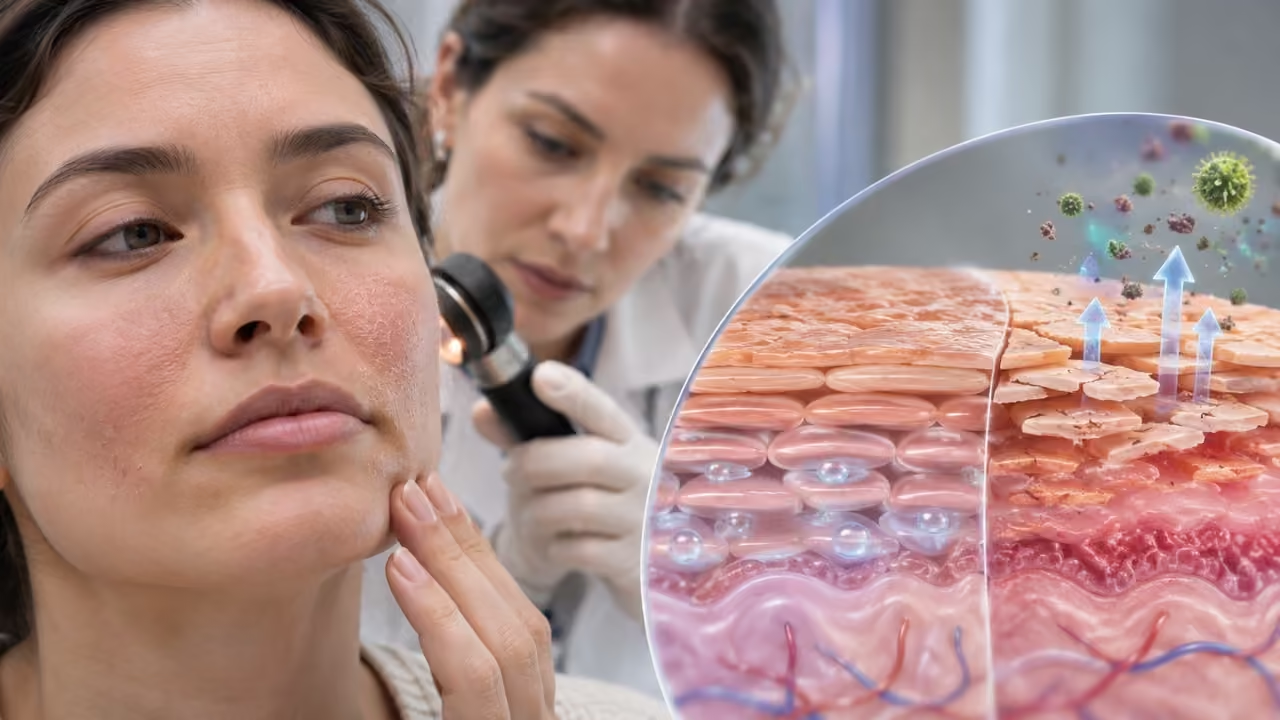
The skin does much more than cover the body. Its outermost layers form a complex protective barrier that limits water loss, blocks harmful microorganisms and irritants, and works closely with the immune system.
When this barrier becomes damaged, skin can become dry, sensitive and inflamed, potentially worsening conditions such as eczema, psoriasis, rosacea and acne.
The American Academy of Dermatology’s latest guidance for National Healthy Skin Month also highlights another important connection: changes in the skin, hair and nails can sometimes provide early clues to health problems elsewhere in the body.
The message is not that ordinary dry or damaged skin directly causes diseases such as diabetes or inflammatory bowel disease. Rather, healthy barrier function is important for controlling skin inflammation, while some visible skin changes can help dermatologists recognize underlying medical conditions.
Table of Contents
What Is the Skin Barrier?
The skin barrier is often described as the body’s first line of defence.
Its outermost portion, the stratum corneum, consists of flattened skin cells surrounded by a matrix rich in lipids such as ceramides, cholesterol and fatty acids.
Together, these structures help:
- prevent excessive water loss;
- keep irritants and allergens outside;
- reduce penetration of bacteria, viruses and fungi;
- maintain an acidic skin environment;
- support beneficial skin microorganisms; and
- coordinate local immune responses.
A recent scientific review in the American Journal of Clinical Dermatology describes the barrier as an integrated system involving physical, chemical, microbial and immune components rather than simply a layer of dead skin cells.
What Happens When the Skin Barrier Is Damaged?
Once barrier integrity declines, water can escape from the skin more easily through a process known as transepidermal water loss.
At the same time, irritants, allergens and microbes may penetrate more easily.
This can trigger or amplify inflammation.
Common signs of a compromised skin barrier include:
- persistent dryness;
- flaking;
- rough or tight skin;
- unusual sensitivity;
- redness or discoloration;
- burning; and
- stinging after skincare products are applied.
The American Academy of Dermatology warns that a weakened barrier may also make skin more vulnerable to infection.
Eczema Can Become Part of a Barrier-Inflammation Cycle
Atopic dermatitis, commonly known as eczema, is one of the clearest examples of how barrier dysfunction and inflammation can reinforce each other.
When the skin barrier becomes more permeable, allergens and microorganisms can penetrate more easily.
The resulting immune response can further interfere with proteins and lipids required for normal barrier function.
Itching then creates another problem.
Scratching mechanically damages the skin, potentially creating a cycle:
barrier disruption → inflammation → itching → scratching → further barrier damage
This is one reason moisturization and barrier-supportive skincare are important components of eczema management alongside appropriate medical treatment.
Skin Barrier Changes Also Matter in Psoriasis
Psoriasis is primarily an immune-mediated inflammatory disease, but research increasingly suggests that barrier dysfunction also participates in the disease process.
Abnormal growth and maturation of skin cells, changes in lipid composition and altered junctions between epidermal cells can all affect barrier integrity.
A damaged barrier does not by itself explain psoriasis, and simply repairing the barrier does not cure the disease.
However, preserving barrier function may help reduce irritation and support broader treatment strategies.
Rosacea and Acne Can Become More Irritated
People with rosacea or acne may also experience problems when the skin barrier is repeatedly disrupted.
Harsh cleansers, aggressive exfoliation or combining several active ingredients can produce redness, burning and increased sensitivity.
This irritation can sometimes be mistaken for worsening of the underlying disease.
For example, a person trying to treat acne may repeatedly use exfoliating acids, retinoids and strong cleansers. Instead of improving the skin, the combination may create additional inflammation.
That is why dermatologists increasingly emphasize a simple and consistent routine, particularly when the skin is already reactive.
Over-Exfoliation Can Damage Healthy Skin
Modern skincare routines can involve numerous active products, but more products do not necessarily mean healthier skin.
According to the AAD, common causes of barrier damage include:
- excessive cleansing;
- very hot water;
- harsh skincare products;
- aggressive physical scrubs;
- frequent chemical exfoliation;
- introducing too many active ingredients together; and
- excessive ultraviolet exposure.
Social-media skincare trends can be particularly problematic when people combine ingredients without considering their cumulative irritating effects.
Skin that suddenly burns or stings after applying products may be signalling barrier disruption rather than a need for stronger treatment.
The Skin Can Also Reflect Internal Health
Skin conditions and systemic diseases are connected in another important way.
Dermatologists are trained to recognize skin, hair and nail changes that may indicate problems elsewhere in the body.
The AAD notes that visible findings can sometimes prompt further investigation for conditions involving:
- diabetes and insulin resistance;
- poor circulation;
- liver or gallbladder disorders;
- autoimmune diseases;
- Crohn’s disease;
- ulcerative colitis;
- vitamin deficiencies; and
- iron deficiency.
For example, certain pigmentation changes may be associated with insulin resistance, while particular rashes can occur with autoimmune or gastrointestinal disease.
These signs are not diagnostic on their own.
A skin finding may simply give a dermatologist a reason to investigate further or recommend appropriate medical testing.
Can Skin Barrier Damage Affect the Whole Body?
Researchers are increasingly studying whether severe barrier disruption can influence immune responses beyond the skin.
Experimental studies suggest that skin injury can release inflammatory signalling molecules capable of producing effects elsewhere in the body.
For example, research published in the Journal of Investigative Dermatology has examined how barrier injury can trigger the immune signalling molecule IL-33 and influence allergic sensitization in experimental models.
These findings support the concept that the skin participates in wider immune communication.
However, they should not be interpreted to mean that everyday dry skin directly causes systemic diseases.
The relationship between skin-barrier dysfunction, immunity and whole-body health is complex and depends heavily on the disease and biological context.
A Simple Routine May Be Better for Barrier Health
For most people, protecting the skin barrier does not require a complicated routine.
The American Academy of Dermatology’s healthy-skin recommendations include:
- Use a gentle cleanser.
- Apply moisturizer regularly.
- Use broad-spectrum sunscreen with SPF 30 or higher.
- Introduce new skincare ingredients gradually.
- Wash with warm rather than very hot water.
- Avoid excessive exfoliation.
- Use shade and sun-protective clothing outdoors.
Moisturizers can be particularly useful because they help limit water loss and support the lipid-rich structure of the outer epidermis.
People with eczema, psoriasis, rosacea or another chronic skin condition may require additional treatment recommended by a dermatologist.
When Should Skin Changes Be Checked?
Skin changes should not always be dismissed as cosmetic problems.
Medical evaluation may be appropriate when there is:
- persistent or severe inflammation;
- unexplained recurring rashes;
- recurrent skin infections;
- intense itching;
- unexplained hair loss;
- non-healing sores;
- unusual pigmentation changes;
- lesions that repeatedly bleed; or
- a mole or spot that changes in size, shape or colour.
Regular self-examination is also important for detecting possible skin cancer.
The AAD recommends paying particular attention to spots that look different from others or that are changing, itching or bleeding.
Healthy Skin Is More Than a Cosmetic Issue
The growing understanding of skin-barrier biology has changed the way scientists view the body’s largest organ.
The barrier is not simply a waterproof covering. It is an active network involving structural proteins, lipids, microorganisms and immune cells.
When that system is disrupted, inflammation and irritation can intensify and chronic skin diseases may become harder to control.
At the same time, skin can provide visible clues about health problems that originate much deeper in the body.
The practical message is relatively straightforward: gentle cleansing, adequate moisturization, sun protection and avoiding unnecessary irritation can help the skin perform its protective role effectively.
And when persistent or unusual changes appear, the skin may be telling more than a cosmetic story.