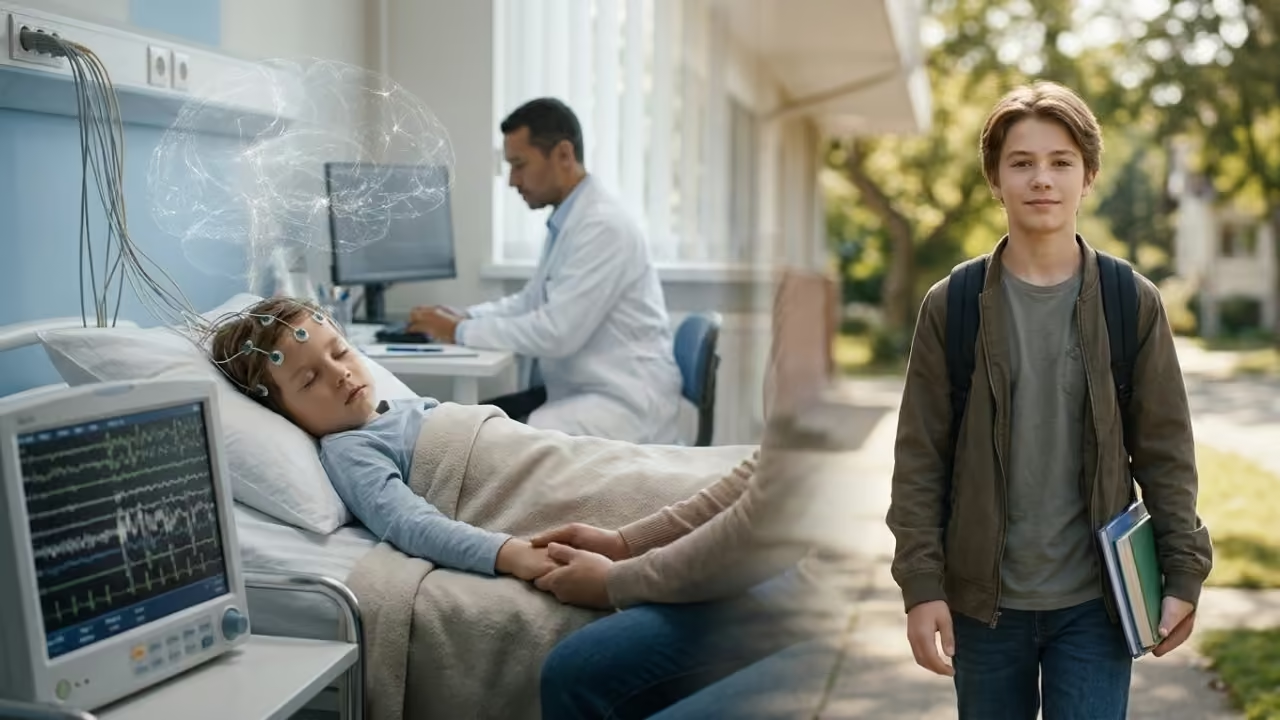
A teenager who began experiencing seizures and developmental regression as a toddler has now been seizure-free for years after doctors identified a rare form of childhood epilepsy in which abnormal brain activity becomes especially intense during sleep.
Christopher Sepúlveda was around 2 years old when his family first noticed involuntary movements of his mouth and eyes, along with episodes in which he would suddenly freeze and remain motionless for nearly two minutes.

His symptoms were initially thought to possibly represent a tic disorder. But over the following months, his condition worsened. Christopher stopped walking, stopped talking and began losing developmental abilities he had previously acquired.
After his family reached Johns Hopkins Children’s Center, pediatric neurologists performed an electroencephalogram, or EEG, and diagnosed him with developmental and epileptic encephalopathy with spike-wave activation in sleep, known as DEE-SWAS.
According to Johns Hopkins Medicine’s original account of Christopher’s case, treatment eventually included several antiseizure medicines and high-dose diazepam. His seizures gradually subsided.

Christopher is now 15, has been seizure-free for years and has required no epilepsy medication since 2019.
Table of Contents
What Is DEE-SWAS?
DEE-SWAS is a rare childhood epilepsy syndrome in which abnormal electrical discharges in the brain become markedly more active during sleep.
The disorder was previously described using terms including continuous spike-wave during slow-wave sleep and electrical status epilepticus in sleep.
A recent peer-reviewed review of DEE-SWAS explains that the condition is characterized not only by seizures but also by developmental, language, behavioral or motor regression associated with intense epileptiform activity during non-REM sleep.
This makes the condition different from epilepsies in which the main clinical problem is visible seizures.
A child may also experience deterioration in:
- speech and language;
- learning;
- memory;
- attention;
- behavior;
- motor abilities.
In some cases, developmental regression can become one of the most important warning signs.
Why Sleep Is So Important
Sleep is normally essential for memory consolidation, learning and brain development.
In DEE-SWAS, however, epileptic electrical discharges become much more prominent during sleep.
Researchers believe this repeated disruption may interfere with normal sleep-dependent brain processes, including synaptic plasticity and memory consolidation.
That helps explain why some children can lose previously acquired skills even when seizures are not constantly visible during the day.
The 2026 clinical review of DEE-SWAS describes the disorder as involving abnormal thalamocortical networks and disrupted sleep-dependent brain function.
Christopher’s Symptoms Became Progressively Worse
Christopher’s family initially noticed unusual facial and eye movements along with episodes of freezing.
But the condition did not remain limited to brief seizure-like events.
Over time, he began losing developmental milestones.
He stopped walking and talking, prompting his family to continue seeking answers after earlier treatments had failed.
The eventual referral to Johns Hopkins Children’s Center led to the EEG that revealed the characteristic sleep-related epileptic activity.
His doctors diagnosed DEE-SWAS and began adjusting treatment.
EEG Can Be Critical for Diagnosis
An EEG records electrical activity in the brain through electrodes placed on the scalp.
For suspected DEE-SWAS, capturing sleep can be particularly important because the abnormal spike-wave activity may increase dramatically during non-REM sleep.
A child whose daytime behavior or routine examination does not reveal the full severity of the condition may show much more striking abnormalities during sleep EEG monitoring.
Modern reviews therefore recommend prolonged sleep EEG as a central part of evaluating suspected DEE-SWAS, often alongside brain MRI, developmental assessment and, increasingly, genetic testing.
Treatment Was Not Straightforward
Christopher did not immediately respond to one treatment.
Johns Hopkins reports that some medicines worked only temporarily.
Early in his treatment, he also experienced a severe seizure during which he became unresponsive and required care in the pediatric intensive care unit.
His medical team continued trying different approaches.
Eventually, treatment included high-dose diazepam, together with other epilepsy medications.
His seizures gradually diminished.
Diazepam belongs to the benzodiazepine class of medicines and can suppress abnormal epileptic activity.
Benzodiazepines are among the treatments used in DEE-SWAS, although they are not the only option.
There Is No Single Best Treatment for Every Child
Christopher’s response to diazepam should not be interpreted as evidence that the same treatment will work for every child with DEE-SWAS.
The syndrome is biologically diverse.
Current evidence suggests that treatment may include:
- benzodiazepines;
- corticosteroids;
- conventional antiseizure medicines;
- epilepsy surgery in selected children with focal structural abnormalities;
- increasingly, cause-specific approaches when a genetic diagnosis is available.
A 2026 review notes that corticosteroids currently have the strongest overall evidence for improving cognitive outcomes, although the quality of evidence remains limited. Benzodiazepines are widely used alternatives.
No medication is specifically approved for every case of DEE-SWAS.
Genetics Can Sometimes Explain the Disorder
DEE-SWAS is not caused by one single genetic abnormality.
A large etiological study of 101 patients found that an underlying cause could be identified in many cases, with a genetic diagnosis found in about one-third of the core cohort.
Researchers identified variants affecting genes involved in:
- ion channels;
- neurotransmission;
- transcriptional regulation;
- brain development.
Structural brain abnormalities can also cause the syndrome.
This diversity is one reason modern specialists increasingly recommend genetic testing alongside EEG and MRI in appropriate children.
Early Recognition May Matter
DEE-SWAS is considered time-sensitive because persistent abnormal electrical activity during sleep may contribute to developmental deterioration.
That creates a strong clinical rationale for identifying and suppressing the abnormal activity as early as possible.
However, “early treatment” should not be presented as a guaranteed cure.
Long-term outcomes vary substantially.
Some children recover important abilities and achieve seizure control.
Others continue to experience difficulties involving:
- language;
- learning;
- behavior;
- memory;
- intellectual development.
The underlying cause, age of onset, duration of abnormal EEG activity and treatment response can all influence outcome.
Christopher Has Been Off Epilepsy Medication Since 2019
Christopher’s long-term progress is particularly encouraging.
Johns Hopkins says he has not needed epilepsy medication since 2019 and has remained seizure-free for years.
Although he experienced developmental delays, he has continued making progress.
At age 15, he is:
- walking;
- talking;
- riding a bicycle;
- doing well at school;
- preparing to begin swimming lessons.
His outcome illustrates what may be possible when an unusual childhood epilepsy is eventually recognized and treated effectively.
But it remains one patient’s experience, not a prediction for every child diagnosed with DEE-SWAS.
Why the Condition Can Be Missed
Early DEE-SWAS symptoms can overlap with other developmental or neurological problems.
Possible warning signs can include:
- unusual staring or freezing episodes;
- facial movements;
- deterioration in language;
- loss of previously acquired skills;
- behavioral change;
- worsening school performance;
- new motor difficulties.
None of these symptoms alone proves that a child has epilepsy.
But developmental regression deserves medical evaluation, particularly when it appears alongside unusual movements or episodes of impaired awareness.
The Condition Can Affect Life Beyond Seizures
Seizure control is only one part of DEE-SWAS management.
Research published in 2026 continues to show that affected children can experience persistent cognitive, behavioral and quality-of-life difficulties.
That means follow-up often needs to involve more than neurology.
Depending on the child, care may include:
- speech and language therapy;
- occupational therapy;
- physical therapy;
- neuropsychological assessment;
- educational support;
- behavioral care.
The ultimate goal is not simply to stop visible seizures but to protect development and help the child recover as much function as possible.
Research Is Moving Toward Precision Treatment
Scientists are increasingly trying to move beyond treating every DEE-SWAS case as the same disorder.
A 2026 review argues that improved genetic diagnosis is beginning to make more personalized treatment possible.
Some genetic forms may eventually respond to therapies targeting the specific biological pathway involved.
Researchers are also studying:
- improved EEG biomarkers;
- better cognitive outcome measures;
- precision genetic therapies;
- new antiseizure medicines;
- optimal timing of corticosteroid treatment.
Larger clinical trials are still needed.
What Christopher’s Story Really Shows
Christopher’s case is not evidence that one medicine can cure rare epilepsy.
Its importance is more practical.
A toddler experiencing seizures and developmental regression was eventually found to have a condition in which abnormal electrical activity became especially intense during sleep.
EEG testing established the diagnosis.
Persistent treatment adjustments eventually controlled the seizures.
Years later, Christopher remains seizure-free and off epilepsy medication while continuing to make developmental progress.
His experience highlights a broader lesson from modern epilepsy care: when a child begins losing previously acquired abilities, identifying an underlying neurological cause quickly can matter, particularly when the abnormal activity may be occurring most intensely while the child sleeps.