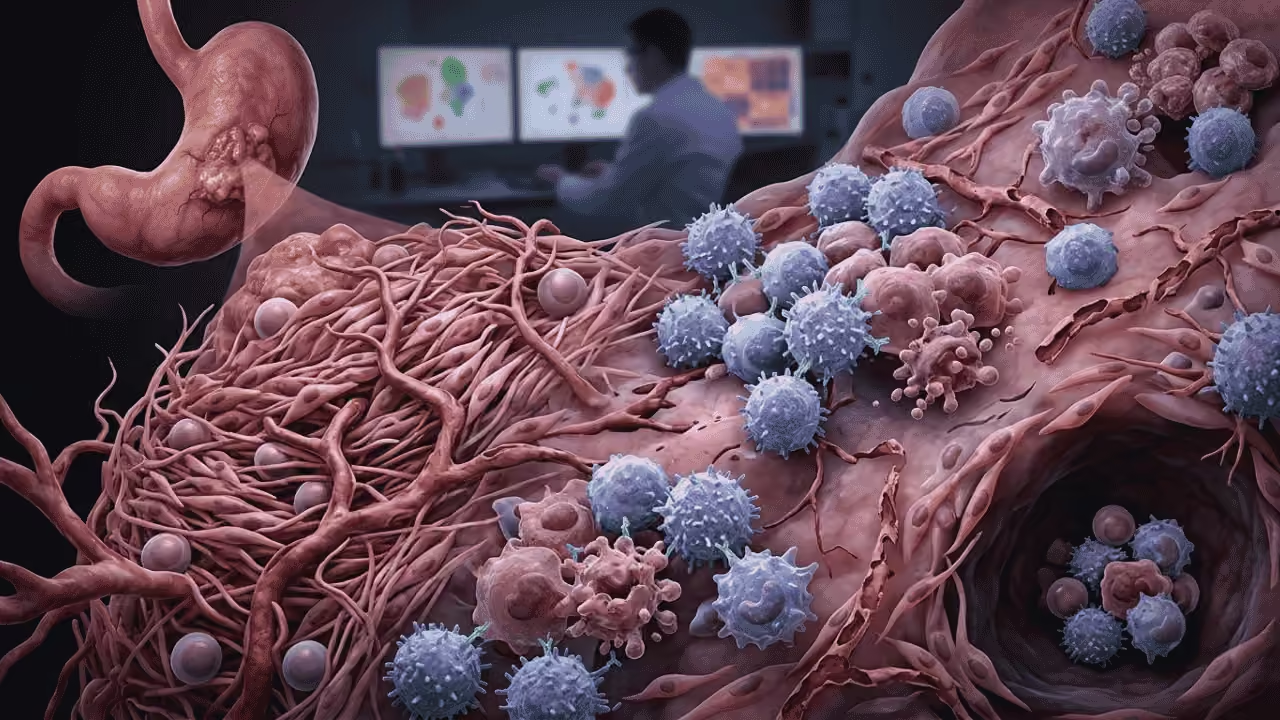
A three-part treatment strategy combining targeted therapy, immunotherapy and chemotherapy produced tumor responses in nearly three-quarters of patients in a small early-stage gastric cancer trial, while also changing the immune environment surrounding the tumors.
Researchers treated 30 patients with advanced gastric cancer using regorafenib, nivolumab and chemotherapy. Twenty-two patients experienced an objective tumor response, corresponding to a response rate of 73%.

But the study published in Science Translational Medicine went substantially further than measuring tumor shrinkage.
By repeatedly sampling tumors before treatment, during therapy and when the cancer progressed, researchers tracked how the regimen altered cancer-fighting T cells, macrophages, regulatory immune cells, fibroblasts and blood-vessel-associated cells.
The results suggest that the treatment temporarily shifted the tumor microenvironment toward a more anti-cancer state, while also revealing new immune populations that appeared as treatment resistance developed.
Table of Contents
What Treatment Did the Patients Receive?
The clinical trial combined three therapeutic strategies:
- regorafenib, a multikinase inhibitor;
- nivolumab, an immune checkpoint inhibitor targeting PD-1;
- platinum-based chemotherapy using either CapeOX or FOLFOX.
Technically, the chemotherapy component itself contains more than one individual drug, so the regimen is more accurately described as a three-part treatment strategy than a literal three-molecule therapy.
The phase 1b/2 trial, known as REGONIVOCTx or EPOC2104, enrolled 30 patients with previously untreated advanced gastric or related gastroesophageal adenocarcinoma.
All patients in the reported molecular-analysis cohort had mismatch repair-proficient, microsatellite-stable tumors.
| Trial Detail | Finding |
|---|---|
| Patients | 30 |
| Trial phase | Phase 1b/2 |
| Treatment | Regorafenib + nivolumab + chemotherapy |
| Objective responses | 22 |
| Objective response rate | 73% |
| Disease control rate | 97% |
| 6-month progression-free survival | 66.7% |
| Journal | Science Translational Medicine |
| Trial identifier | NCT05394740 |
The earlier ASCO report from the REGONIVOCTx trial confirmed that 22 of 30 patients responded, meeting the study’s predefined primary endpoint.
Why the Tumor Microenvironment Matters
A tumor is not composed only of malignant cells.
It also contains:
- immune cells;
- connective-tissue cells;
- blood vessels;
- signaling molecules;
- stromal cells.
Together, these form the tumor microenvironment.
Some components help the immune system attack cancer.
Others can protect the tumor by suppressing immune activity, limiting T-cell access or promoting abnormal blood-vessel growth.
This environment is one reason immunotherapy can work extremely well in some patients but poorly in others.
The researchers wanted to understand whether adding regorafenib to nivolumab and chemotherapy could make gastric tumors more immunologically responsive.
Cancer-Fighting CD8+ T Cells Increased
One of the clearest changes involved CD8+ T cells.
These immune cells can recognize and kill malignant cells.
After treatment, researchers observed an increase in tumor-antigen-reactive CD8+ T cells inside the tumor microenvironment.
That finding is important because nivolumab works by blocking PD-1, a molecular brake that can suppress T-cell activity.
If more tumor-reactive T cells are present and their inhibitory signaling is reduced, the immune system may become more capable of attacking malignant cells.
The study therefore provides biological evidence supporting the clinical responses seen in many patients.
M1-Like Macrophages Also Increased
The researchers also observed an increase in M1-like pro-inflammatory macrophages.
Macrophages are highly flexible immune cells.
Some macrophage states can support anti-tumor immunity, while others can help tumors suppress immune responses and grow.
The treatment appeared to shift part of this population toward a more inflammatory, anti-tumor state.
This was another sign that the regimen was changing the overall immune ecosystem rather than acting only on cancer cells directly.
Regulatory T Cells Fell During Treatment
Another major change involved CCR8-positive regulatory T cells, or Tregs.
Regulatory T cells normally help prevent excessive immune activation.
Inside tumors, however, they can suppress the very T cells that researchers want to attack cancer.
The combination therapy reduced activated CCR8+ Tregs during treatment.
This may have removed some of the local immune suppression and helped CD8+ T cells function more effectively.
However, the story changed when tumors later developed resistance.
At progression, these CCR8+ regulatory T cells began to expand again.
That suggests the tumor environment was able to partially rebuild its immunosuppressive defenses.
Cancer-Associated Fibroblasts Were Suppressed
The treatment also reduced a population of stromal cells known as LRRC15+ cancer-associated fibroblasts.
Cancer-associated fibroblasts can influence:
- immune-cell movement;
- tumor structure;
- extracellular matrix;
- treatment resistance;
- immune suppression.
LRRC15+ fibroblasts have attracted particular interest because they may contribute to an environment that prevents effective immune attack.
Their reduction suggests the regimen may have altered not only immune cells but also the tumor’s structural support system.
Unlike the regulatory T cells, these fibroblasts remained reduced even when some cancers later progressed.
Other Tumor-Supporting Cells Declined Too
Researchers identified reductions in several additional populations associated with tumor support.
These included:
- RGS5+ pericytes;
- APLN+ tip cells.
Both cell types are associated with tumor blood-vessel biology.
Regorafenib inhibits multiple kinase pathways involved in angiogenesis, which may help explain these vascular changes.
Reducing abnormal blood-vessel support could potentially improve the tumor environment for immune-cell infiltration.
Why Regorafenib May Strengthen Immunotherapy
Regorafenib blocks several signaling pathways involved in:
- angiogenesis;
- tumor-cell growth;
- stromal support;
- immune suppression.
Nivolumab, meanwhile, removes inhibitory PD-1 signaling from T cells.
Chemotherapy directly damages rapidly dividing tumor cells and can also alter antigen release and immune signaling.
The underlying strategy is therefore complementary:
chemotherapy attacks tumor cells + nivolumab releases immune inhibition + regorafenib reshapes the tumor environment.
The new biopsy data provide evidence that this interaction is occurring inside human tumors.
Tumors Changed Again When Resistance Developed
One of the most important features of the study was that researchers also collected samples when cancers progressed.
The tumors did not simply return to their original state.
Some treatment-induced changes persisted, while new resistant cell populations appeared.
Activated CCR8+ Tregs expanded again.
Researchers also identified an increase in APOC1+ lipid-associated macrophages, a population associated with immune suppression.
This suggests that cancers can adapt to therapy by creating new biological routes around an initially successful immune response.
Researchers Found Potential New Resistance Targets
The team then tested some of these resistance mechanisms experimentally.
In mouse models of acquired resistance, they targeted suppressive immune populations with antibodies against:
- CCR8;
- TREM2.
When these treatments were combined with PD-1 blockade, anti-tumor immune activity was restored in the experimental models.
This is an important translational finding.
It suggests that studying how tumors change during treatment may identify the targets needed for the next generation of combination therapies.
However, anti-CCR8 and anti-TREM2 combinations have not been proven effective for these patients in clinical trials.
The Objective Response Rate Was 73%
Clinically, the triplet strategy produced objective tumor responses in 22 of 30 patients.
That equals 73%.
The disease control rate was 97%, while the 6-month progression-free survival rate was 66.7%, according to the ASCO trial analysis.
These figures are encouraging.
But they need to be interpreted in the context of the trial design.
This was a:
- small study;
- single-arm study;
- non-randomized study;
- early-phase trial.
There was no control group receiving nivolumab plus chemotherapy without regorafenib.
Therefore, the study cannot establish how much additional benefit specifically came from regorafenib.
Nivolumab Plus Chemotherapy Is Already an Established Treatment
Nivolumab combined with fluoropyrimidine- and platinum-based chemotherapy is already used in advanced gastric and gastroesophageal cancers.
A large randomized trial previously demonstrated survival benefits from adding nivolumab to chemotherapy in selected patients.
The new question is whether adding regorafenib can further improve the treatment by remodeling the tumor microenvironment.
The current study provides biological and early clinical support for that idea, but a randomized comparison is still required.
Safety Was Manageable but Not Trivial
The ASCO trial report documented several grade 3 or higher treatment-related adverse events.
The most common included:
- neutropenia: 33%;
- elevated AST or ALT liver enzymes: 13%;
- hypertension: 13%;
- leukopenia: 7%.
No dose-limiting toxicities were observed during the phase 1b safety lead-in.
Researchers therefore described the safety profile as acceptable in the context of advanced cancer therapy.
That does not mean the regimen was free of significant side effects.
Why Microsatellite-Stable Tumors Matter
All 30 patients had microsatellite-stable or mismatch repair-proficient tumors.
This is important because mismatch repair-deficient gastric cancers can be particularly responsive to immune checkpoint inhibitors.
Microsatellite-stable cancers are often more challenging from an immunotherapy perspective.
Finding a way to make these tumors more immunologically active is therefore an important treatment goal.
The observed increase in tumor-reactive CD8+ T cells suggests the combination may be changing that immune context.
Repeated Biopsies Make This Study Unusual
Many clinical trials measure tumor response through scans and survival.
This research added something more detailed.
Investigators performed:
- single-cell RNA sequencing;
- T-cell receptor sequencing;
- repeated tumor biopsies.
Samples were analyzed at:
- baseline;
- during treatment;
- disease progression.
This allowed researchers to watch the tumor ecosystem change over time rather than obtaining only one biological snapshot.
That longitudinal approach is one of the study’s main strengths.
The Regimen Is Not Yet a New Standard of Care
Despite the strong response rate, the combination remains investigational.
The study has not yet shown that adding regorafenib produces:
- longer overall survival;
- longer progression-free survival than existing treatment;
- better quality of life;
- benefits across all gastric cancer subtypes.
A randomized phase 3 trial would be needed to answer those questions.
The ASCO investigators have stated that further randomized testing is planned.
Why the Findings Matter
The significance of the study goes beyond a 73% response rate.
Researchers were able to observe the biological sequence that accompanied treatment:
tumor-reactive CD8+ T cells increased → suppressive T cells and fibroblasts declined → tumor immunity strengthened → resistant immune populations later emerged.
This provides a roadmap for understanding both treatment response and treatment failure.
Instead of treating resistance as a single endpoint, the researchers identified specific cell populations that might eventually be targeted when tumors begin adapting.
What the Study Really Shows
The trial does not prove that regorafenib, nivolumab and chemotherapy are superior to current first-line treatment.
It shows that this three-part strategy produced encouraging responses in a small group of patients and caused measurable restructuring of the tumor microenvironment.
That restructuring increased anti-tumor immune cells while reducing several immune-suppressive and tumor-supporting populations.
When resistance eventually appeared, the tumor environment evolved again, revealing additional targets that could potentially be exploited in future trials.
That dynamic view of cancer treatment may ultimately be the study’s most important contribution.