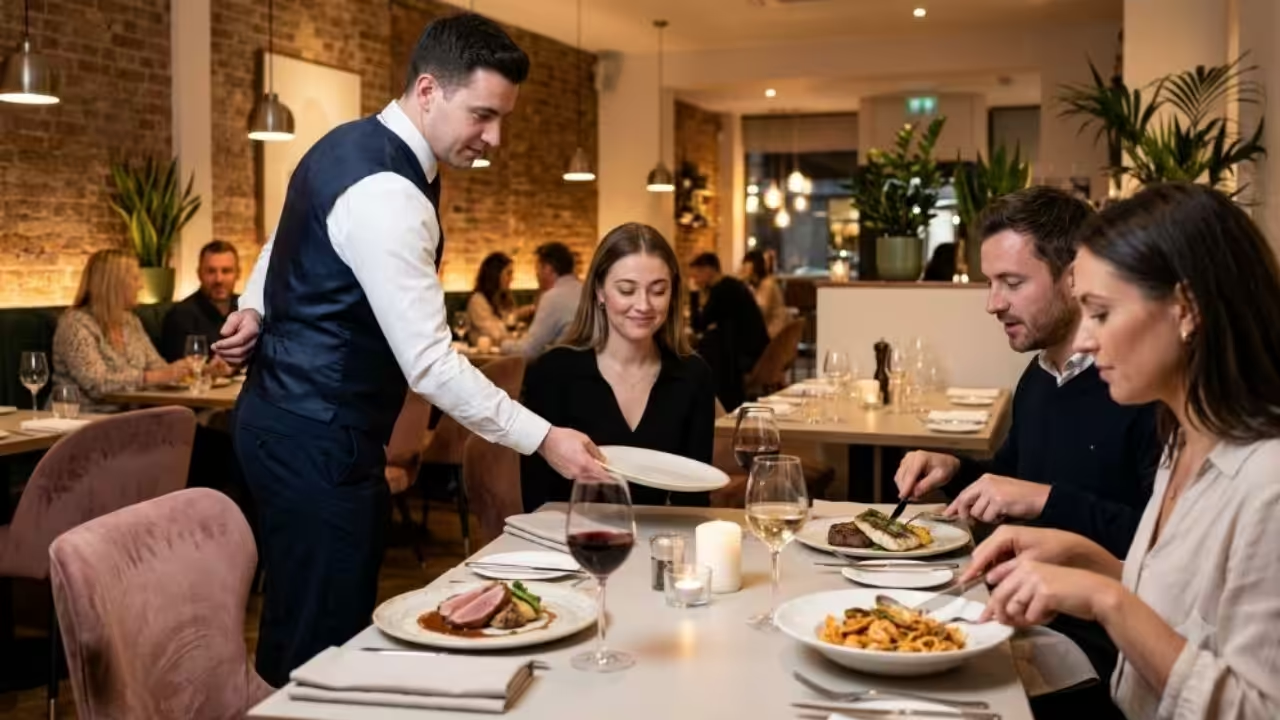
A familiar restaurant moment is drawing fresh attention to the gap between traditional dining etiquette and modern service practices. One guest finishes eating, a server promptly removes the empty plate, and the rest of the table suddenly feels as though the meal has acquired a deadline.
Although early clearing can feel like a subtle request to leave, restaurant professionals say that is not always the intention. In many establishments, staff members remove finished dishes to control clutter, prepare for the next course and keep service moving. Etiquette specialists, however, maintain that the main plates should ordinarily remain until everyone has finished.
Table of Contents
Traditional Etiquette Says the Table Should Finish Together
Under conventional Western dining etiquette, servers should wait until everyone at the table has completed a course before clearing the plates. The practice recognises a restaurant meal as a shared social occasion rather than as several individual meals happening in the same place.
Taking away one guest’s plate can unintentionally place attention on those who are still eating. A slower diner may feel responsible for delaying dessert, the bill or the restaurant’s next seating. Even when no one says anything, an empty space beside an occupied plate can create pressure.
Jacqueline Whitmore, founder of the Protocol School of Palm Beach, said that all diners should generally finish before the table is cleared. This convention remains particularly relevant at formal dinners, business meals, banquets and fine-dining establishments.
Modern Restaurants Often Follow a Different System
Many casual restaurants now use a practice called pre-busing. It involves removing items that guests no longer need while the party is still seated. These may include empty bread baskets, used appetiser dishes, finished glasses and individual dinner plates.
Pre-busing gives customers more room, particularly at small tables crowded with serving dishes, condiments and drinks. It also prevents used tableware and food scraps from remaining in front of guests for an extended period.
Operationally, gradual clearing divides the workload more evenly. Instead of collecting all plates and glasses at once, employees return used items to the dishwashing area throughout the meal. Industry guidance on how restaurant staff clear tables describes pre-busing as an established part of maintaining an organised dining space.
Early Clearing is Not Necessarily a Signal to Leave
Customers sometimes interpret a disappearing plate as evidence that the restaurant wants to turn the tables quickly. Table turnover is important to the business, especially when reservations are waiting, but early clearing can have less confrontational explanations.
A server may be preparing space for dessert or removing a dish containing bones, sauces or unwanted food. Staff may also be following instructions to keep their assigned tables free of unnecessary items. In some restaurants, a manager could view uncleared dishes as evidence that a server is not paying attention.
Restaurant consultant Salar Sheik told Fox News that removing a finished plate is not automatically an attempt to hurry customers. The way it is done makes the difference. A quick, polite request can appear attentive, while hovering over someone who is still eating is more likely to feel intrusive.
Servers Look for Clues That a Diner is Finished
Restaurant workers often rely on body language before approaching a table. Common signals include a diner leaning back, placing utensils together, leaving little or no food, looking around for the server or showing no interest in the plate for several minutes.
None of these clues is foolproof. Someone may stop eating to tell a story, answer a call or wait for a drink. A diner may also leave a small amount of food while deciding whether to continue.
That uncertainty makes a simple question the most dependable option. Asking, “May I clear your plate?” allows the customer to confirm without creating an awkward exchange. If the guest has not finished, a polite response is sufficient; there is no obligation to release the plate merely because a server has reached for it.
Silverware Can Send a Silent Message
Traditional table manners provide a visual cue that a course is complete. Diners can place the knife and fork together on the plate, with the handles pointing toward approximately four o’clock.
The Emily Post Institute’s dining guidance recommends this position as the appropriate finished signal. It also advises diners to leave the plate where it was served, rather than pushing it toward the centre or edge of the table.
Utensil codes are not universal, however. Their meanings can differ among countries, restaurants and service traditions. Crossed utensils may indicate a pause in some settings, but not every server receives formal training in these signals. Clear communication, therefore, remains more reliable than expecting staff to decode cutlery placement.
Stacking Plates May Not be as Helpful as It Looks
Some diners stack their dishes to make clearing easier. The gesture is usually well-intentioned, but restaurant employees may prefer that customers leave their plates untouched.
Professional clearing methods account for the size and weight of dishes, the position of utensils and the amount of food remaining. An unstable stack assembled by a customer may hide knives, napkins, sauce or small bowls. It can also be harder to lift safely.
Pushing plates away is similarly discouraged under formal etiquette. Customers who need more space can ask the server to remove finished items rather than rearranging the table themselves. This allows staff members to use the clearing method required by their workplace.
Service Style Changes the Rules
Fine-dining restaurants usually coordinate the table as a whole. Plates are often presented together, courses are paced carefully, and clearing begins only when every guest has finished. Casual restaurants are more likely to remove individual dishes as they become available.
Family-style service creates another variation. Empty communal dishes may be cleared immediately, while personal plates remain until the course ends. At fast-paced establishments, cleanliness, table space and speed may take priority over formal conventions.
Large groups also require flexibility. Leaving dozens of finished dishes in place can crowd the table and complicate service, so employees may clear in stages after receiving permission. Expectations may also vary internationally, making it difficult to apply one etiquette rule to every dining room.
Courtesy Remains the Best Rule
Traditional etiquette supports waiting until the entire table has finished, but modern restaurant operations explain why many servers now clear plates individually. In most cases, servers aim to keep the table comfortable and the service organised, not to force customers out.
The best approach is a small moment of communication. Servers can ask before lifting a plate, and diners can comfortably say they are still eating. That brief exchange removes the guesswork and allows efficiency and hospitality to exist at the same table.