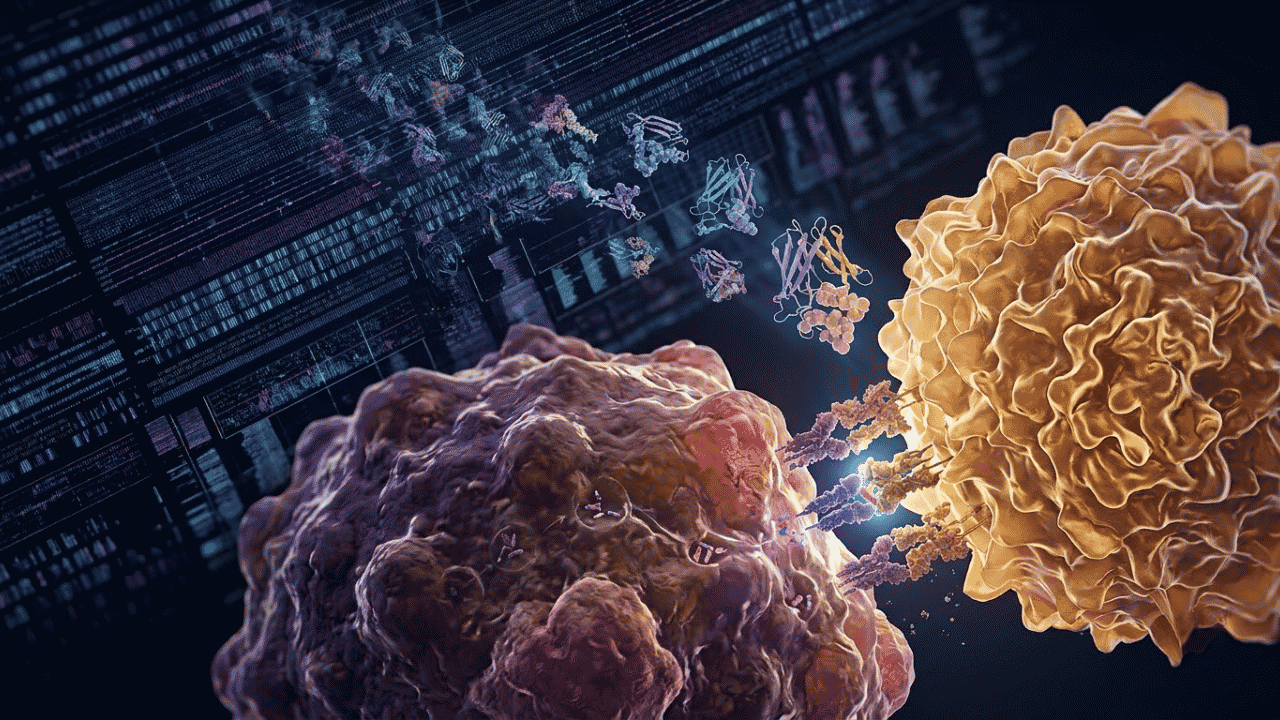
Scientists have mined genomic data from around 150,000 tumor samples and uncovered shared immune receptors that can recognize cancer-associated targets across different patients.
The research identified recurring T cell receptors, or TCRs, directed against well-known cancer antigens including mutated KRAS, human papillomavirus proteins and CT83. Researchers also characterized 11 families of shared TCRs, nine of which had not previously been described.
According to the study published in Science Translational Medicine, the team went beyond computational prediction and experimentally validated 44 TCRs across nine peptide-HLA targets, including receptors capable of potent cytotoxic activity.
The study does not introduce a new cancer treatment yet. Instead, it shows that large-scale clinical sequencing data may contain a largely untapped library of cancer-targeting immune receptors that could accelerate development of future TCR-based immunotherapies.
Table of Contents
Researchers Analyzed Around 150,000 Tumor Samples
The study used bulk RNA sequencing data generated through routine clinical genomics testing.

The dataset included tumor samples from more than 30 types of advanced cancer.
From those samples, researchers reconstructed approximately 26 million unique T cell receptor chains and then searched for receptor sequences that appeared repeatedly in patients sharing the same cancer-associated antigen or HLA context.
| Study Detail | Finding |
|---|---|
| Tumor samples analyzed | ~150,000 |
| Cancer types | More than 30 |
| Unique TCR chains screened | ~26 million |
| Shared TCR families characterized | 11 |
| Previously unknown families | 9 |
| TCRs experimentally validated | 44 |
| Peptide-HLA targets tested | 9 |
| Journal | Science Translational Medicine |
| Publication date | 4 November 2026 |
The scale allowed researchers to detect immune patterns that would be extremely difficult to identify in conventional studies involving dozens or hundreds of patients.
What Is a T Cell Receptor?
T cells are immune cells capable of detecting infected or abnormal cells.
Each T cell carries a T cell receptor on its surface.
These receptors recognize short fragments of proteins, known as peptides, displayed by molecules called human leukocyte antigens, or HLA.
When a TCR recognizes a peptide associated with cancer, the T cell can become activated and attack the cell displaying it.
That ability makes TCRs potentially valuable for cancer immunotherapy.
The challenge is finding receptors that reliably recognize tumor antigens without attacking healthy tissue.
Most TCRs Are Highly Individual
The human immune system contains an enormous diversity of T cell receptors.
Most TCR sequences are relatively uncommon and may occur in only one person or a small number of people.
Researchers call these “private” receptors.
But some TCRs appear repeatedly in unrelated individuals.
These are known as public TCRs.
The new study was based on the idea that if several patients independently generate similar TCRs against the same cancer antigen, those receptors could potentially become useful starting points for therapies that work across groups of patients rather than being developed completely from scratch for each individual.
KRAS Was One of the Important Targets
Among the tumor-associated antigens identified by the researchers were peptides derived from mutated KRAS.
KRAS is one of the most frequently altered cancer-driving genes.
Mutations in KRAS are common in several major cancers, including:
- pancreatic cancer;
- colorectal cancer;
- lung cancer.
Historically, KRAS was regarded as difficult to target directly with drugs.
Newer targeted therapies can inhibit some specific KRAS mutations, but many patients still lack effective mutation-specific options.
TCRs offer a different strategy.
Instead of blocking KRAS itself, an engineered T cell could potentially recognize a mutant KRAS peptide displayed on the surface of a tumor cell.
Researchers Also Found HPV-Associated TCRs
The pipeline also identified receptors associated with proteins from human papillomavirus, or HPV.
Persistent infection with certain HPV strains can contribute to cancers including:
- cervical cancer;
- anal cancer;
- some head and neck cancers.
Because viral proteins differ from normal human proteins, they can provide attractive targets for immune-based therapies.
The presence of recurring HPV-reactive TCRs across patients supports the broader idea that large clinical datasets can reveal shared immune responses to common cancer-driving antigens.
CT83 Was Another Cancer-Associated Target
Researchers also identified TCR chains associated with CT83, a cancer-testis antigen.
Cancer-testis antigens are normally expressed in a limited range of tissues but can become activated in tumors.
That restricted expression can make them interesting therapeutic targets because they may provide greater separation between cancer cells and most healthy tissues.
The discovery of public TCRs against CT83 adds another potentially useful class of receptors to the dataset.
The Team Had to Reconstruct Full Receptors
Finding one TCR chain is not enough to create a functional receptor.
T cell receptors are formed from paired alpha and beta chains.
Bulk RNA sequencing often identifies these chains separately, meaning researchers must determine which alpha chain belongs with which beta chain.
The team therefore developed computational approaches to pair enriched TCR-alpha and TCR-beta sequences.
They then reconstructed complete receptors in the laboratory and tested whether those receptors recognized the predicted cancer-associated peptide-HLA complexes.
Forty-Four Receptors Were Experimentally Validated
This experimental step is one of the study’s major strengths.
The researchers validated 44 TCRs across nine distinct peptide-HLA targets.
Some of the receptors demonstrated strong cytotoxic activity, meaning engineered T cells carrying them could kill cells presenting the corresponding cancer antigen under laboratory conditions.
This moves the findings beyond statistical association.
The study shows that at least some of the receptor sequences discovered through large-scale computational mining are functional and capable of recognizing biologically relevant cancer targets.
Nine Previously Unknown TCR Families Emerged
Researchers characterized 11 shared receptor families across patient populations.
Nine had not previously been described.
Members of a TCR family do not necessarily have identical sequences.
Instead, they can share structural or sequence characteristics that allow them to recognize the same peptide-HLA target.
This kind of immune convergence is important because it suggests different patients can independently generate related receptor solutions to the same cancer antigen.
That could make shared receptor families particularly useful for immunotherapy development.
Routine Cancer Sequencing May Contain Far More Information Than Expected
One of the most important aspects of the study is methodological.
Tumor sequencing is usually performed to identify:
- cancer-driving mutations;
- biomarkers;
- treatment targets;
- resistance mechanisms.
But tumor tissue also contains immune cells.
RNA sequencing of those samples can therefore capture fragments of T cell receptor sequences as well.
The researchers showed that these immune sequences can be recovered and analyzed across extremely large patient populations.
In effect, data originally collected for precision oncology can also become a resource for immune-receptor discovery.
Why This Could Accelerate TCR Therapy Development
Traditional discovery of tumor-reactive TCRs can be slow and technically demanding.
Researchers may need:
- fresh tumor samples;
- viable tumor-infiltrating lymphocytes;
- single-cell sequencing;
- antigen screening;
- receptor reconstruction;
- extensive laboratory validation.
Rare cancers and heavily treated patients can make those samples difficult to obtain.
The new approach instead uses data already generated during routine clinical testing.
That could allow researchers to search tens or hundreds of thousands of patients simultaneously and prioritize the most promising recurrent receptors before committing to expensive functional experiments.
Could These Become ‘Off-the-Shelf’ Cancer Treatments?
Potentially, but that description needs qualification.
Public TCRs could make some immunotherapies more standardized because a validated receptor might potentially be used for multiple patients.
But TCR therapies remain highly dependent on HLA type.
A TCR does not recognize a tumor peptide by itself.
It recognizes a specific peptide displayed by a particular HLA molecule.
That means a patient would generally need both:
- the relevant cancer antigen;
- the HLA molecule recognized by the TCR.
A receptor useful for one HLA background may therefore be ineffective in another.
So public TCRs could broaden treatment availability without becoming universally applicable.
How TCR Therapy Works
One potential approach is TCR-engineered T cell therapy.
Doctors collect T cells from a patient and genetically engineer them to express a selected cancer-targeting TCR.
Those engineered cells are then expanded and returned to the patient.
If the receptor correctly identifies the tumor antigen, the T cells can attack cancer cells displaying it.
This concept is related to CAR T cell therapy, but the recognition mechanism differs.
CAR T cells generally target molecules directly on the surface of cancer cells.
TCRs can recognize peptides derived from proteins located inside the cancer cell, as long as those peptides are presented on HLA molecules.
That potentially provides access to a much larger set of cancer targets.
The Study Does Not Show Patient Benefit Yet
This is an important limitation.
The researchers successfully discovered and experimentally validated cancer-specific TCRs.
But the study did not demonstrate:
- tumor shrinkage in patients;
- improved survival;
- long-term safety;
- successful clinical TCR therapy;
- efficacy across all cancer types.
The strongest evidence comes from computational analysis and laboratory validation.
Before any receptor becomes a treatment, researchers would need extensive safety testing followed by clinical trials.
Safety Is Particularly Important for TCR Therapies
A receptor that strongly recognizes cancer cells can still be dangerous if it also binds a similar peptide from a normal human protein.
This is known as cross-reactivity.
Any candidate receptor intended for therapy therefore needs careful testing to determine:
- how specifically it recognizes its intended target;
- whether it reacts with healthy tissues;
- how strongly it activates T cells;
- whether the targeted antigen is consistently present in tumors.
The newly identified receptor families are therefore starting points for therapeutic development rather than ready-made medicines.
Why the Scale of the Study Matters
The most significant advance may be the ability to search immune repertoires across tens of thousands of patients at once.
Cancer immunology has traditionally relied heavily on detailed studies of relatively small cohorts.
This research reverses that model.
It begins with an enormous real-world clinical dataset, identifies recurring immune patterns computationally and then brings selected candidates back into the laboratory for validation.
The AAAS summary of the study describes these patient-derived immune repertoires as a valuable resource that has largely remained untapped.
A New Resource Hidden Inside Existing Cancer Data
The study suggests that vast repositories of clinical genomic data may contain more than information about the tumor itself.
They also contain traces of the immune system’s attempt to recognize that cancer.
By comparing those immune responses across enough patients, scientists can identify recurring receptor patterns that would otherwise remain hidden.
That creates a potentially scalable pathway:
clinical tumor sequencing → immune repertoire mining → public TCR discovery → laboratory validation → therapeutic development
The final steps remain challenging, but the first part of that pipeline can now operate at a scale that was previously difficult to achieve.
What the Study Really Shows
Researchers did not discover a universal cancer receptor.
They discovered something more technically useful: a method for finding shared cancer-reactive TCRs across very large patient populations.
From roughly 150,000 tumor samples and 26 million receptor chains, they identified recurring immune patterns against established cancer antigens and experimentally confirmed dozens of functional receptors.
That suggests routine clinical genomics data may hold a substantial reservoir of immune molecules that could eventually feed the next generation of precision cancer therapies.