
Every year, after NEET UG results are declared, hundreds of thousands of students and their families face one of the most consequential decisions in a young person’s life , should they pursue MBBS at a government medical college, or consider a private one?
For some families, the answer is straightforward. A government seat at a prestigious institution like NMCH Patna, PMCH, or AIIMS is the dream, and if it is achieved, the decision is made. But for the many students who fall just short of government college cutoffs , or who are weighing their options strategically , the government versus private question is genuinely complex, emotionally charged, and financially significant.
This article does not tell you which choice is right. What it does is lay out an honest, realistic, and comprehensive comparison of government and private medical colleges in India across every dimension that matters , fees, clinical exposure, infrastructure, career outcomes, reputation, and quality of life. Armed with this information, you can make a decision that is right for your specific situation, aspirations, and financial reality.
Table of Contents
The Fee Gap: The Most Obvious Difference
The single most dramatic difference between government and private medical colleges in India is the cost of education. This gap is so significant that it fundamentally shapes everything else about the decision.
Government Medical College Fees
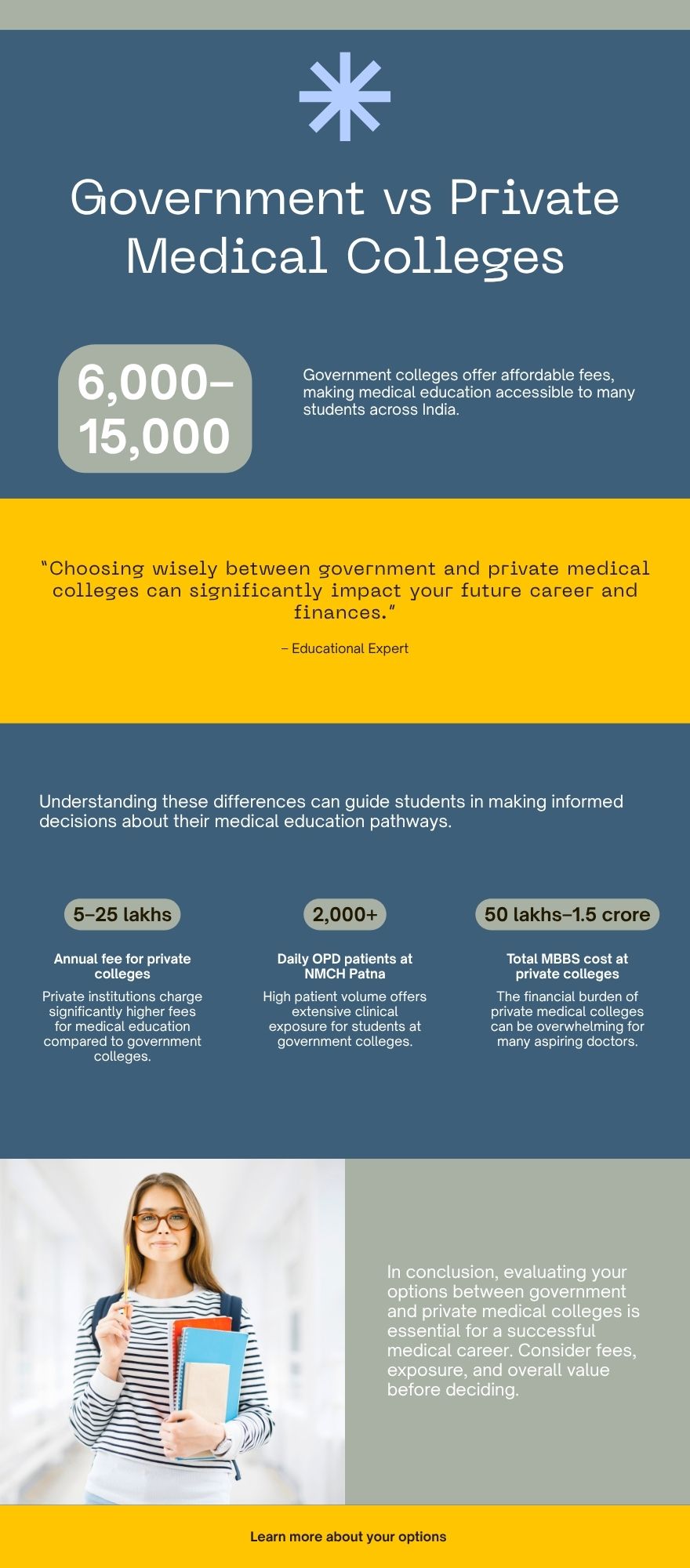
At government medical colleges like NMCH Patna, the annual tuition fee for MBBS is in the range of Rs. 6,000 to Rs. 15,000 per year, depending on the state and institution. Even accounting for hostel fees, mess charges, examination fees, and personal expenses, the total annual cost of studying MBBS at a government college rarely exceeds Rs. 50,000 to Rs. 1,00,000 per year.
Over the full five and a half year MBBS programme, the total cost of a government medical education , including all expenses , typically falls in the range of Rs. 3 lakhs to Rs. 6 lakhs. This is an extraordinarily affordable figure for a professional degree of this calibre.
Private Medical College Fees
Private medical college fees in India vary enormously depending on the institution, state, and management quota versus merit quota. However, even at the lower end of the private medical college fee spectrum, annual tuition fees typically start at Rs. 5 lakhs to Rs. 10 lakhs per year. At premium private medical colleges and deemed universities, annual fees can reach Rs. 20 lakhs to Rs. 25 lakhs or more.
Over the full MBBS programme, the total cost of a private medical education , including tuition, hostel, and other expenses , commonly ranges from Rs. 50 lakhs to Rs. 1.5 crore or more, depending on the institution. Management quota seats, which bypass merit-based admission and are allocated at the discretion of the college management, often carry even higher fees and additional donations.
The Financial Reality
The fee gap between government and private medical colleges in India is not just large , it is potentially life-altering. Families taking on Rs. 50 lakhs to Rs. 1 crore in loans or liquidating assets to fund a private medical education are making a bet on future earnings that carries significant financial risk.
A doctor graduating from a private medical college with Rs. 80 lakhs of debt and a further Rs. 20 to 30 lakhs needed for PG preparation and potential PG college fees faces a financial burden that can take a decade or more to clear. This financial pressure can drive career decisions , forcing doctors into high-earning urban private practice rather than the public health or research roles they might have preferred , and can generate enormous personal stress during the early years of a medical career.
This is not to say that private medical education is never worth the cost. But the financial implications must be understood clearly and honestly before the decision is made.
Clinical Exposure: Where Government Colleges Hold a Decisive Advantage
One area where government medical colleges in India , particularly high-volume institutions like NMCH Patna , hold a clear and significant advantage over most private colleges is clinical exposure.
Patient Volume at Government Colleges
Government teaching hospitals in India see patient volumes that most private college hospitals simply cannot match. NMCH Patna, for instance, manages over 2,000 outpatients daily across its departments, in addition to a large inpatient load, emergency cases, and surgical cases. Across the full range of specialities , Medicine, Surgery, Paediatrics, Obstetrics and Gynaecology, Orthopaedics, Psychiatry, and more , the sheer variety and complexity of cases encountered is extraordinary.
For a medical student, this patient volume translates directly into clinical learning. A student at a high-volume government hospital like NMCH will, over the course of five and a half years, encounter clinical scenarios that a student at a lower-volume private college hospital may simply never see. They will have personally examined hundreds of patients, assisted in dozens of procedures, and developed a level of clinical confidence and competence that is genuinely difficult to acquire in a lower-volume environment.
Case Mix and Complexity
Government hospitals in India also tend to see a case mix that is skewed towards more complex, advanced, and unusual presentations , for the simple reason that patients who come to government hospitals are often those who have exhausted other options, or who have been referred from smaller facilities with conditions that require tertiary care.
This means that government medical students encounter rare tropical diseases, advanced malignancies, complex obstetric emergencies, severe nutritional deficiencies, and multi-system disorders that are less commonly seen at private hospitals, where the patient population tends to be less severely ill.
Infrastructure at Private Colleges
To be fair, many well-funded private medical colleges have invested heavily in infrastructure , modern buildings, well-equipped simulation labs, digital learning resources, and comfortable hostel facilities that often exceed what is available at government colleges. The physical environment at top private colleges can be significantly more polished than at government institutions, where infrastructure maintenance is subject to government funding cycles.
However, infrastructure is not a substitute for clinical exposure. A beautifully equipped simulation lab is a valuable supplement to clinical training , it is not a replacement for it. Students who learn medicine primarily through simulation and low-volume clinical postings emerge less clinically prepared than those who have managed real patients in high-volume environments, regardless of how modern their college building is.
Reputation and Recognition: Does It Matter Where You Study?
One of the most common questions asked by students considering private medical colleges is whether the college’s reputation will affect their career prospects. The honest answer is nuanced.
The MBBS Degree Is Standardised
All MBBS degrees awarded by medical colleges recognised by the National Medical Commission are legally equivalent. A doctor who graduated from NMCH Patna holds exactly the same qualification as a doctor who graduated from a private medical college , the MBBS degree is an MBBS degree, regardless of where it was obtained.
In terms of NEET PG performance , which is the key determinant of postgraduate admission , what matters is how well the candidate prepared and how strong their clinical foundation is, not which college they attended. Many of India’s top NEET PG rankers come from government medical colleges, and their performance reflects the quality of their training and preparation rather than any institutional advantage.
Where Reputation Does Matter
College reputation begins to matter more at the level of superspeciality training, research fellowships, and academic appointments. Institutions with stronger research output, more active alumni networks, and better faculty credentials do offer certain advantages in these competitive fields.
NMCH Patna, as a government institution with over 55 years of history and a large and active alumni network, carries genuine institutional credibility. Its graduates are recognised and respected across Bihar and beyond, and the institution’s affiliation with Bihar University of Health Sciences and recognition by the NMC ensures that its degrees are accepted everywhere.
Quality of Faculty: A Mixed Picture
Faculty quality is another important variable in the government versus private comparison, and the picture here is genuinely mixed.
Government medical colleges attract faculty through state government service rules, which provide job security, pension benefits, and structured career progression. Senior faculty at institutions like NMCH often have decades of clinical experience and genuine expertise in their specialities , the product of years of high-volume practice in a demanding public hospital environment.
However, government faculty recruitment can be slow, and vacancies sometimes persist for extended periods. Faculty-to-student ratios at government colleges are not always ideal, and the administrative burdens placed on government doctors can limit the time and energy available for teaching.
Private medical colleges, particularly well-funded ones, can often attract and retain qualified faculty by offering competitive salaries and better working conditions. However, the quality of private college faculty varies enormously , from excellent at the top private institutions to deeply inadequate at colleges that were established primarily as commercial enterprises.
The key point is that faculty quality should be evaluated institution by institution, not assumed based on government or private status alone.
Student Life and Campus Environment
The student life experience at government and private medical colleges differs in several important ways.
Government medical colleges like NMCH tend to have a more diverse student body , students from a wide range of economic, social, and geographic backgrounds who have earned their seats purely on merit. This diversity is culturally enriching and professionally valuable, exposing students to perspectives and experiences they would not encounter in more homogeneous environments.
The campus environment at government colleges is generally less polished than at well-funded private institutions , the hostels may be older, the canteen food less varied, and the non-academic facilities more basic. However, the shared experience of navigating a demanding government hospital environment builds resilience, adaptability, and a practical problem-solving orientation that serves doctors well throughout their careers.
Private college campuses often offer superior amenities , better hostels, more recreational facilities, and a more comfortable physical environment. For students who place high value on comfort and campus aesthetics, this is a genuine consideration.
Bond and Service Obligations
Government medical college graduates in most Indian states, including Bihar, are subject to bond and service obligations that require them to serve in rural or government healthcare facilities for a specified period after graduation. Failure to fulfil these obligations attracts financial penalties.
Private medical college graduates are generally not subject to these bond requirements, giving them greater immediate freedom of career choice after graduation.
For students who plan to pursue postgraduate education immediately after internship, the bond requirement at government colleges can create complications , although many state governments have provisions for deferring bond service for candidates who secure PG admission. Students should clarify the current bond conditions with NMCH administration before making their decision.
Making the Decision: A Framework for Thinking It Through
Given everything discussed above, how should a NEET aspirant think through the government versus private decision? A few guiding principles can help.
If you have secured a government seat , take it. The combination of affordable fees, excellent clinical exposure, and nationally recognised degree makes a government medical seat at an institution like NMCH Patna one of the best investments in professional education available in India. There is very rarely a compelling reason to choose a private college over a government seat, unless the specific private institution offers demonstrably superior training in a speciality you are passionate about.
If you are considering a private college because you narrowly missed the government cutoff , think carefully about the financial implications. Calculate the total cost of the private college education, the loan burden you would carry, and the realistic earnings trajectory of a doctor in your early career years. If the numbers are unmanageable, it may be worth considering repeating NEET UG for one more year to improve your score and secure a government seat.
If you are considering a private college for genuine academic reasons , a specific speciality programme, research opportunities, or faculty expertise that is not available at government colleges near you , make sure you have thoroughly researched the institution’s accreditation, NMC recognition, hospital patient volume, and faculty credentials before committing.