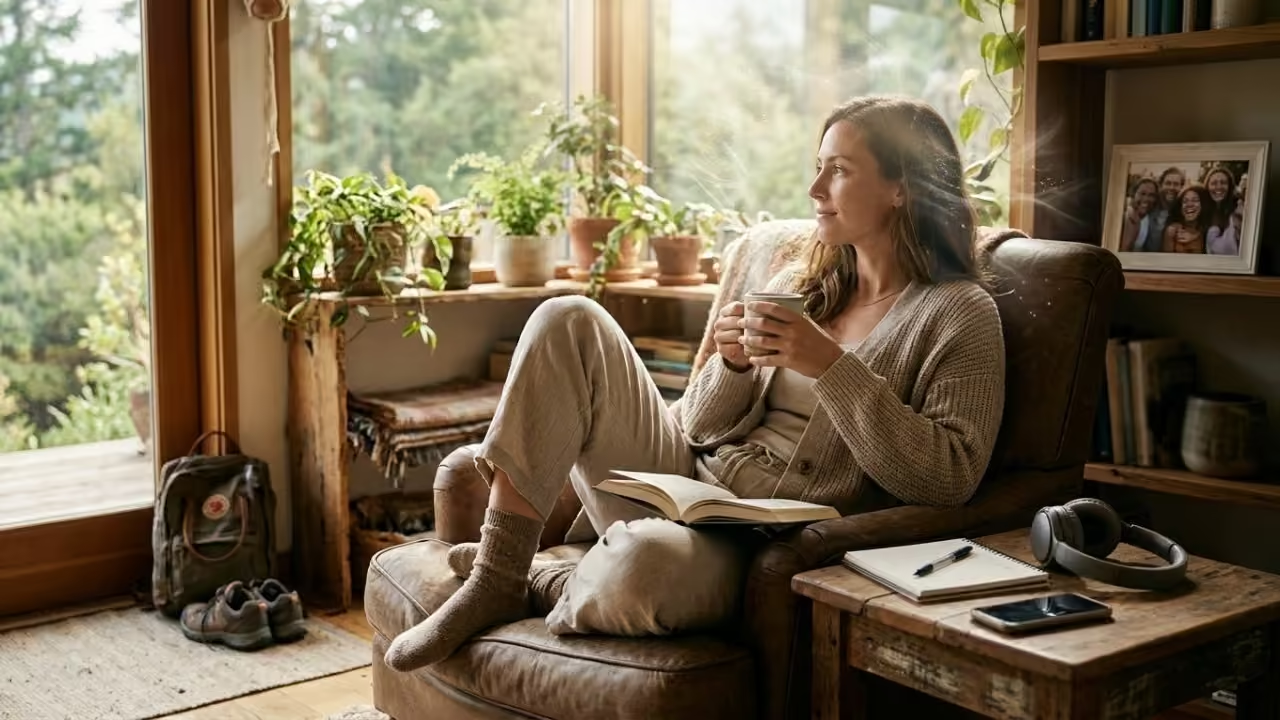
Some people can spend an afternoon alone reading, walking, working on a hobby or simply thinking and emerge feeling restored. Others find the same amount of solitude uncomfortable or lonely.
Psychology research suggests the difference is more complicated than simply being an introvert.

One of the clearest findings is that people who experience solitude positively often have a strong sense of autonomy, they feel that spending time alone is their own choice and fits naturally with what they want to do.
A study examining who actually enjoys solitude found that autonomous functioning consistently predicted self-determined motivation for spending time alone, whereas introversion did not reliably predict either enjoying solitude or preferring it.
More recent research has reinforced the idea that solitude can be beneficial across many personality types, provided it is voluntary, meaningful and balanced with satisfying social relationships.
Table of Contents
1. They Often Have a Strong Sense of Autonomy
Autonomy is probably the most strongly supported characteristic associated with positive solitude.
In psychology, autonomy does not simply mean independence or refusing help from other people.
It refers to feeling that your behavior reflects your own interests, values and choices rather than pressure from others.
Researchers studying solitude found that people with higher dispositional autonomy were more likely to spend time alone for self-determined reasons.
They might choose solitude because they genuinely enjoy:
- reading;
- creating something;
- walking;
- listening to music;
- thinking;
- resting;
- pursuing a hobby.
They are not necessarily alone because they dislike social interaction.
They simply experience time alone as something they have chosen.
2. They Do Not Necessarily Need to Be Introverts
One of the most interesting findings challenges a common stereotype.
People who enjoy solitude are often assumed to be introverts.
But the PLOS ONE research found no consistent evidence that introversion predicted self-determined motivation for solitude.
A broader Journal of Personality synthesis of recent solitude research reached a similar conclusion: solitude can be actively sought and enjoyed across a surprisingly wide range of personality types.
An extroverted person may enjoy an evening alone after a socially demanding day.
An introverted person may dislike being alone if the solitude feels forced.
Personality matters, but the context and motivation appear to matter just as much.
3. They Are Comfortable Making Their Own Choices
People who enjoy solitude may be less dependent on external stimulation when deciding what to do.
Instead of needing another person’s presence to make an activity worthwhile, they can create satisfying experiences independently.
This does not mean they reject relationships.
Rather, they may find it easier to decide:
“I want to do this because I enjoy it.”
That sense of personal agency appears to make solitude feel less like social deprivation and more like psychological space.
Research on daily well-being supports this distinction.
A three-week diary study examining psychological needs during solitude found that autonomy satisfaction while alone was particularly associated with feelings of peacefulness and greater satisfaction with the day.
4. They Often Use Solitude Purposefully
How people spend time alone also appears to matter.
Solitude itself is neither automatically beneficial nor harmful.
Research involving emerging adults found that different solitary activities were associated with different psychological outcomes.
People might use solitude for:
- creative activities;
- hobbies;
- exercise;
- media;
- relaxation;
- reflection.
A Journal of Personality study examining what people actually do while alone found that active solitary leisure tended to be associated with better adjustment than spending alone time primarily caught in thought.
This distinction is important.
Reflecting on life can be useful.
But uncontrolled rumination, repeatedly dwelling on distressing thoughts, can turn solitude into a psychologically difficult experience.
The quality of alone time matters at least as much as the quantity.
5. They May Use Solitude to Regulate Stress
Solitude can also act as a way of lowering stimulation.
A large daily-life study found an interesting trade-off.
On days when participants spent more time alone, they generally reported less stress and greater autonomy, although longer periods alone could also be associated with greater loneliness and lower overall satisfaction.
The crucial factor was whether solitude was voluntary.
When people felt they had chosen to be alone, many of the negative associations weakened or disappeared.
The researchers concluded that there is no universal amount of solitude that is ideal for everyone.
For some people, an hour alone after work may provide recovery.
For others, that same hour may feel isolating.
6. They Can Feel Peaceful Without Constant Social Stimulation
Another characteristic of positive solitude is the ability to experience lower stimulation without interpreting it as something negative.
Social environments involve constant information:
- conversation;
- facial expressions;
- expectations;
- responses;
- noise;
- decisions.
Solitude temporarily reduces many of those demands.
For someone comfortable with being alone, this quieter environment can produce feelings of calm rather than boredom.
Research on psychological needs found that autonomy during solitude was strongly connected with peaceful affect.
That makes positive solitude different from loneliness.
The person may be alone without feeling that something important is missing.
7. They Still Need Meaningful Social Relationships
Enjoying solitude does not remove the basic human need for social connection.
This distinction is perhaps the most important one.
Research repeatedly separates:
solitude: being physically alone;
from
loneliness: feeling that one’s desired social connection is missing.
A person can spend many hours alone and not feel lonely.
Another person can feel intensely lonely while surrounded by other people.
The 21-day diary research found that extra solitude sometimes increased loneliness, but this relationship weakened substantially when the time alone was freely chosen.
Other research suggests that satisfaction of social needs during actual interactions remains important for emotional well-being.
Healthy solitude therefore usually exists alongside meaningful relationships, not instead of them.
8. They May Be More Comfortable With Self-Connection
Solitude provides an unusual opportunity to pay attention to one’s own thoughts and interests without adapting continuously to other people’s expectations.
For some people, this creates a stronger feeling of self-connection.
They may use alone time to:
- clarify priorities;
- pursue personal interests;
- process experiences;
- recover from stimulation;
- make decisions without immediate external influence.
This again connects closely with autonomy.
Someone who understands what they value may find solitary time easier to structure and enjoy.
9. Age Can Change How People Experience Solitude
The relationship with solitude may also change across the lifespan.
Research suggests that older adults can become particularly skilled at using solitude positively.
With age, people often become more selective about how they spend time and which relationships they prioritize.
Solitude may therefore increasingly represent intentional recovery or self-connection rather than unwanted isolation.
But this does not mean all older adults benefit from being alone.
Unwanted social isolation remains associated with poorer well-being, particularly when meaningful relationships are absent.
Enjoying Solitude Does Not Mean Disliking People
Perhaps the biggest misconception is that people who enjoy solitude are socially detached.
The research does not support such a simple conclusion.
A person can simultaneously:
- enjoy close friendships;
- value family relationships;
- participate actively in social life;
- enjoy substantial periods alone.
The recent Journal of Personality synthesis emphasizes that solitude experiences emerge from an interaction between personality, motivation, situation and activity, rather than from one personality trait alone.
This means asking “Are you an introvert?” may be less informative than asking:
“Why are you choosing to be alone, and what are you doing with that time?”
Chosen Solitude and Forced Isolation Are Very Different
A weekend spent alone because someone wants quiet time is psychologically different from a weekend spent alone because nobody is available to see them.
The physical situation may look identical.
The psychological experience can be completely different.
Researchers describe the first as potentially self-determined solitude.
The second can feel like social exclusion or isolation.
That distinction helps explain why studies sometimes appear contradictory.
Some find that being alone improves calm and reduces stress.
Others link isolation with poorer mental and physical health.
Both can be correct because they are studying different experiences.
There Is No Perfect Amount of Alone Time
Psychology research has not identified a universal daily quota for healthy solitude.
The 21-day diary study found no evidence for a single ideal balance between socializing and solitude that maximizes well-being for everyone.
Instead, the effects depend on:
- personal preference;
- whether solitude is chosen;
- what someone does while alone;
- the quality of their social relationships;
- how long solitude continues;
- their emotional state.
That is why the same quiet evening can feel restorative to one person and deeply uncomfortable to another.
What Psychology Research Really Says
People who genuinely enjoy spending time alone do not fit one universal personality profile.
They are not necessarily introverts.
They are not automatically more intelligent, emotionally stronger, more creative or less interested in relationships.
The most consistent scientific pattern points instead toward autonomy.
People tend to experience solitude more positively when they choose it willingly, feel free to direct their own time and engage in activities that feel personally worthwhile.
Solitude can then offer calm, autonomy and recovery.
But when time alone is unwanted, prolonged or disconnected from meaningful relationships, the same physical state can turn into loneliness.
The difference between healthy solitude and isolation may therefore depend less on being alone than on why someone is alone and how that time is experienced.