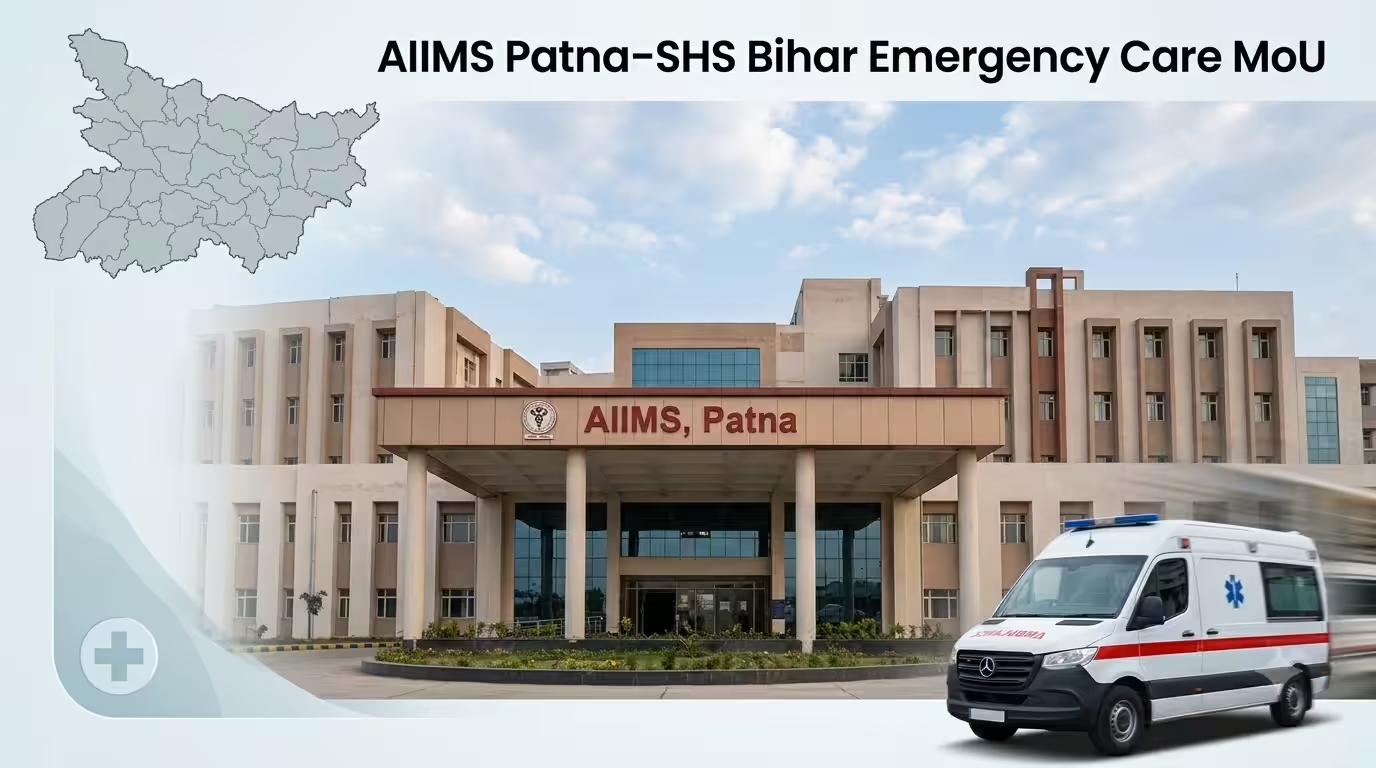
AIIMS Patna and the State Health Society (SHS), Bihar, have entered into a major collaboration to strengthen emergency medical care across the state. The two institutions have signed a Memorandum of Understanding (MoU) to establish a standardised emergency healthcare network connecting AIIMS Patna with government medical colleges, district hospitals, and peripheral health facilities.
The initiative is designed to ensure that patients facing life-threatening emergencies receive timely and standardised treatment irrespective of the government health facility they initially approach. It will focus on common emergency-care protocols, coordinated referrals, clinical mentoring, workforce training, and technology-assisted medical support.

Under the proposed model, AIIMS Patna will function as the Apex Technical Resource Centre, while 13 government medical colleges in Bihar will serve as regional hubs supporting hospitals and health centres within their respective areas.
Table of Contents
AIIMS Patna-SHS Bihar MoU Details
| Particular | Details |
|---|---|
| Initiative | Statewide standardised emergency healthcare network |
| Institutions | AIIMS Patna and State Health Society, Bihar |
| Purpose | Strengthen emergency and critical-care services across Bihar |
| Apex Technical Resource Centre | AIIMS Patna |
| Regional hubs | 13 government medical colleges |
| Facilities to be supported | District hospitals, sub-divisional hospitals and Community Health Centres |
| Major focus | Standardised treatment, triage, referrals and clinical support |
| Digital interventions | Tele-ICU, tele-emergency consultation and digital learning |
| Technology component | AI-enabled clinical decision-support systems |
| Workforce development | Training for doctors, nurses, paramedics and emergency personnel |
| Major emergencies covered | Trauma, heart attack, stroke, poisoning, snakebite, burns, obstetric emergencies and other critical illnesses |
Why AIIMS Patna and Bihar Health Society Have Signed the MoU
One of the central objectives of the collaboration is to reduce differences in the quality and approach to emergency treatment across Bihar’s government healthcare facilities.
A patient suffering from a stroke, major trauma, or heart attack may initially reach a Community Health Centre, sub-divisional hospital or district hospital rather than a tertiary medical institution. Effective treatment during this initial period can substantially influence the patient’s subsequent course of care.

The proposed network, therefore, focuses not only on tertiary treatment but also on strengthening the first stages of emergency management.
Hospitals participating in the initiative are expected to adopt common clinical protocols, uniform triage practices, and evidence-based treatment guidelines so that emergency teams can quickly identify the severity of a patient’s condition and initiate appropriate treatment.
AIIMS Patna to Function as Apex Technical Resource Centre
AIIMS Patna will have a central technical and academic role under the new arrangement.

Rather than limiting the programme to isolated training sessions, the institute is expected to provide continuous mentoring and specialist support to government healthcare teams across Bihar.
The support framework includes:
- Tele-emergency consultations
- Clinical mentoring
- Virtual grand rounds
- Supportive supervision
- Quality audits
- Regular capacity-building programmes
- Technical guidance for emergency departments
The arrangement could enable clinicians working at district and peripheral hospitals to obtain guidance from specialists when managing complicated emergency cases.
Bihar to Develop Hub-and-Spoke Emergency Care Network
One of the most important components of the MoU is the creation of a hub-and-spoke emergency healthcare network.
Under the proposed structure:
AIIMS Patna → 13 Government Medical Colleges → District Hospitals → Sub-Divisional Hospitals and Community Health Centres
AIIMS Patna will operate as the apex hub. The state’s 13 government medical colleges are proposed to serve as regional hubs, providing clinical and technical mentoring to government hospitals and health facilities within their networks.
The structure is intended to extend specialist knowledge beyond tertiary hospitals and create a connected emergency-care system across Bihar. It is particularly significant for patients in districts located far from major tertiary hospitals, where immediate access to specialists may otherwise be limited.
Common Triage System to Improve Emergency Response
The programme envisages the introduction of common triage systems across participating hospitals.
Triage is a critical component of emergency medicine in which patients are assessed and prioritised according to the severity of their condition. Patients with immediately life-threatening conditions require rapid intervention, while comparatively stable patients can be treated according to their clinical priority.
Standardising triage across hospitals can help emergency teams quickly identify very sick patients and make better use of the emergency resources they have. Hospitals will also receive support for improving the organisation of emergency departments and patient-flow systems.
Major Medical Emergencies Covered Under the Programme
The standardised treatment framework is expected to cover several conditions in which treatment delays can have serious consequences. These include:
Trauma
Road accidents, falls, serious injuries, and other trauma cases frequently require immediate stabilisation, assessment, and referral.
Heart Attack
Rapid recognition and treatment of acute cardiac emergencies can be crucial in limiting damage and improving outcomes.
Stroke
Stroke management is highly time-sensitive. Standardised recognition and referral protocols could help patients reach appropriate facilities faster.
Poisoning
Emergency teams will receive structured guidance on evaluating, stabilising, and managing patients with poisoning.
Snakebite
Snakebite continues to require rapid medical assessment and appropriate treatment, particularly in rural areas where patients may initially report to peripheral health facilities.
Burns
Severe burn injuries require early stabilisation, fluid management and appropriate referral depending on the extent and severity of the burns.
Obstetric Emergencies
The programme also encompasses serious pregnancy- and childbirth-related emergencies requiring urgent stabilisation and specialist intervention.
Other critical and potentially life-threatening illnesses will also fall within the broader emergency-care framework.
Coordinated Referral Network Between Hospitals
Another key component of the programme is a structured referral system connecting lower-level hospitals with facilities capable of providing advanced treatment.
Currently, transferring a critically ill patient from one facility to another can become complicated when there is inadequate communication regarding the patient’s condition and the availability of specialist care or treatment already provided.
The proposed network seeks to develop defined referral pathways.
A patient who requires advanced intervention could therefore be stabilised at the initial healthcare facility before being transferred through a predetermined referral route to an appropriate higher centre. Communication between the referring and receiving hospitals is also expected to be strengthened.
Focus on Saving the ‘Golden Hour’
Emergency medicine frequently emphasises the importance of providing appropriate treatment as early as possible after a serious medical event.
The new AIIMS Patna-SHS Bihar initiative specifically seeks to minimise avoidable delays during this crucial period.
For serious trauma and several other acute conditions, rapid assessment, stabilisation, and transfer to an appropriate facility can be critical.
By combining standardised protocols with a coordinated referral mechanism, the programme aims to ensure that valuable time is not lost while determining where or how a critically ill patient should be treated.
Tele-ICU Support to Connect Specialists With Hospitals
Technology will play an important role in the proposed emergency healthcare network.
Tele-ICU support is among the digital interventions planned as part of the collaboration.
Tele-ICU systems can enable clinicians working at remote or smaller facilities to obtain specialist critical-care support without requiring the specialist to be physically present at the hospital.
The programme also envisages tele-emergency consultations, allowing medical professionals at district and other government hospitals to seek expert guidance while managing difficult cases. Such a network could be especially useful where specialist emergency or critical-care expertise is not continuously available locally.
AI-Enabled Clinical Decision Support Planned
Artificial intelligence is also expected to form part of the technological framework. The collaboration proposes introducing AI-enabled clinical decision-support systems.
Such systems are intended to assist healthcare professionals in assessing clinical information and making timely decisions. They would function as support tools for medical teams rather than replacing clinical judgement.
The technology component could eventually help standardise emergency assessment and facilitate the quicker identification of high-risk patients when appropriately integrated with clinical protocols.
Emergency Medicine Registries to Support Better Monitoring
The initiative also envisages the development of emergency medicine registries.
Structured data on emergency cases can help health authorities understand factors such as:
- Types of emergencies being treated
- Patient outcomes
- Referral patterns
- Treatment delays
- Facility-level performance
- Common causes of critical illness
- Areas requiring additional resources or training
Such data can also support quality-improvement programmes and help policymakers identify weaknesses in Bihar’s emergency-care network.
Digital Learning Platform for Healthcare Workers
The collaboration includes provisions for digital learning as part of its capacity-building strategy.
Digital training platforms can allow healthcare personnel working outside major medical institutions to access standardised educational resources, clinical protocols and updated training material.
This approach is particularly relevant for a statewide network because training requirements extend beyond doctors to nurses, paramedics and other emergency personnel working across different levels of the health system.
Doctors, Nurses and Paramedics to Receive Competency-Based Training
Human-resource development is another major pillar of the MoU.
Doctors, nurses, paramedics, and emergency personnel are expected to receive competency-based emergency care training.
Training methods proposed under the programme include:
- Simulation-based exercises
- Workshops
- Bedside teaching
- Standardised training modules
- Clinical mentoring
- Continuous professional support
Simulation training can be particularly useful in emergency medicine because medical teams can practise managing critical situations in a controlled environment before encountering similar scenarios during actual patient care.
Hospitals to Receive Support for Strengthening Emergency Departments
The initiative does not focus solely on individual healthcare professionals.
Government hospitals will also receive institutional support to strengthen the way their emergency departments function.
Areas likely to receive attention include emergency department organisation, patient flow, triage procedures, clinical protocols, referral mechanisms and quality monitoring.
This is important because an effective emergency department depends not only on trained doctors but also on coordinated systems involving nurses, technicians, paramedics, diagnostic facilities, communication systems and referral services.
Continuous Monitoring Instead of One-Time Training
A notable feature of the programme is its emphasis on continuous improvement.
Government healthcare capacity-building programmes can sometimes rely heavily on periodic training sessions. The AIIMS Patna-SHS Bihar arrangement envisages an ongoing relationship involving clinical mentoring, supervision, audits and technical support.
Virtual grand rounds could allow clinicians from multiple facilities to review cases and discuss treatment practices with specialists.
Quality audits could, meanwhile, identify recurring problems and areas requiring corrective measures.
The approach, therefore, attempts to establish an institutional emergency-care network rather than merely conducting a series of workshops.
Who Signed the AIIMS Patna-SHS Bihar MoU?
The MoU was signed on behalf of the State Health Society, Bihar, by Brinda Lal, Joint Secretary-cum-In-Charge (Training).
Prof. Dr. Prashant Kumar Singh, Medical Superintendent, AIIMS Patna, signed the agreement on behalf of AIIMS Patna.
The agreement was signed in the presence of Prof. (Brig.) Dr. Raju Agarwal, Executive Director and CEO of AIIMS Patna.
The collaboration was publicly announced in early August 2026 as an initiative to create a uniform emergency-care system across Bihar.
What AIIMS Patna Says About the Initiative
AIIMS Patna Executive Director and CEO, Prof. (Brig.) Dr Raju Agarwal, has emphasised that the programme aims to build a stronger emergency healthcare system capable of providing timely, high-quality care.
A major part of the strategy will be strengthening district-level healthcare institutions through continuing academic and technical support from AIIMS Patna and the regional medical college hubs.
The underlying objective is straightforward: the standard of initial emergency treatment should not depend entirely on whether a patient reaches a major tertiary hospital or a district-level government facility.
Why the MoU Could Be Important for Bihar’s Public Healthcare System
The significance of the agreement lies in the scale of the proposed network.
Bihar’s healthcare system serves a large population spread across urban centres, small towns and rural areas. Patients requiring emergency treatment cannot always reach a tertiary-care institution immediately.
Strengthening emergency departments closer to patients can therefore be as important as expanding highly specialised facilities.
The hub-and-spoke arrangement aims to leverage the specialised resources available at AIIMS Patna and government medical colleges to enhance clinical capacity across multiple levels of the public health system.
If effectively implemented, the model could improve three particularly important components of emergency care:
Early recognition: Healthcare workers identify serious conditions quickly.
Early stabilisation: Essential treatment begins before transfer.
Appropriate referral: Patients requiring advanced treatment are directed to the right facility without unnecessary delays.
Technology and Training Are Central to the New Model
The AIIMS Patna-SHS Bihar partnership combines three major approaches rather than relying on a single intervention.
First, it aims to standardise clinical management through uniform protocols and triage systems.
Second, it creates an institutional support network connecting peripheral facilities with government medical colleges and AIIMS Patna.
Third, it introduces digital technologies such as Tele-ICU, tele-emergency services, digital education, emergency registries and AI-based clinical decision support.
Training and continuous mentoring will run alongside these interventions.
This combination is intended to make emergency-care improvement sustainable rather than dependent on individual hospitals or specialists.
What Patients Could Gain From the Emergency Care Network
For patients, the effectiveness of the programme will ultimately depend on how extensively it is implemented at the hospital level.
The intended benefits include:
- Faster identification of critically ill patients
- More standardised emergency treatment
- Improved stabilisation before referral
- Faster access to specialist advice
- Better communication between hospitals
- Reduced referral delays
- Stronger emergency services at district hospitals
- Improved capacity among doctors, nurses and paramedics
- Better use of digital health technologies
- More coordinated movement of critical patients to higher centres
The initiative could be particularly valuable for time-sensitive emergencies, where even short delays can affect clinical outcomes.
A Major Step Towards an Integrated Emergency Healthcare System
The MoU between AIIMS Patna and the State Health Society, Bihar, represents an attempt to move emergency medicine in the state towards an integrated network-based model.
Instead of treating AIIMS Patna, government medical colleges, district hospitals and Community Health Centres as isolated units, the proposed system seeks to connect them through standardised protocols, defined referral pathways, specialist mentoring, digital technology and continuous training.
With AIIMS Patna functioning as the Apex Technical Resource Centre and 13 government medical colleges serving as regional hubs, the initiative has the potential to extend specialist emergency-care expertise much deeper into Bihar’s public health system.
Its long-term impact will depend on effective hospital-level implementation, availability of trained personnel, technological connectivity, adherence to standardised protocols and sustained coordination among participating institutions. If these elements are successfully put in place, the partnership could substantially strengthen Bihar’s capacity to respond to trauma and other life-threatening medical emergencies.