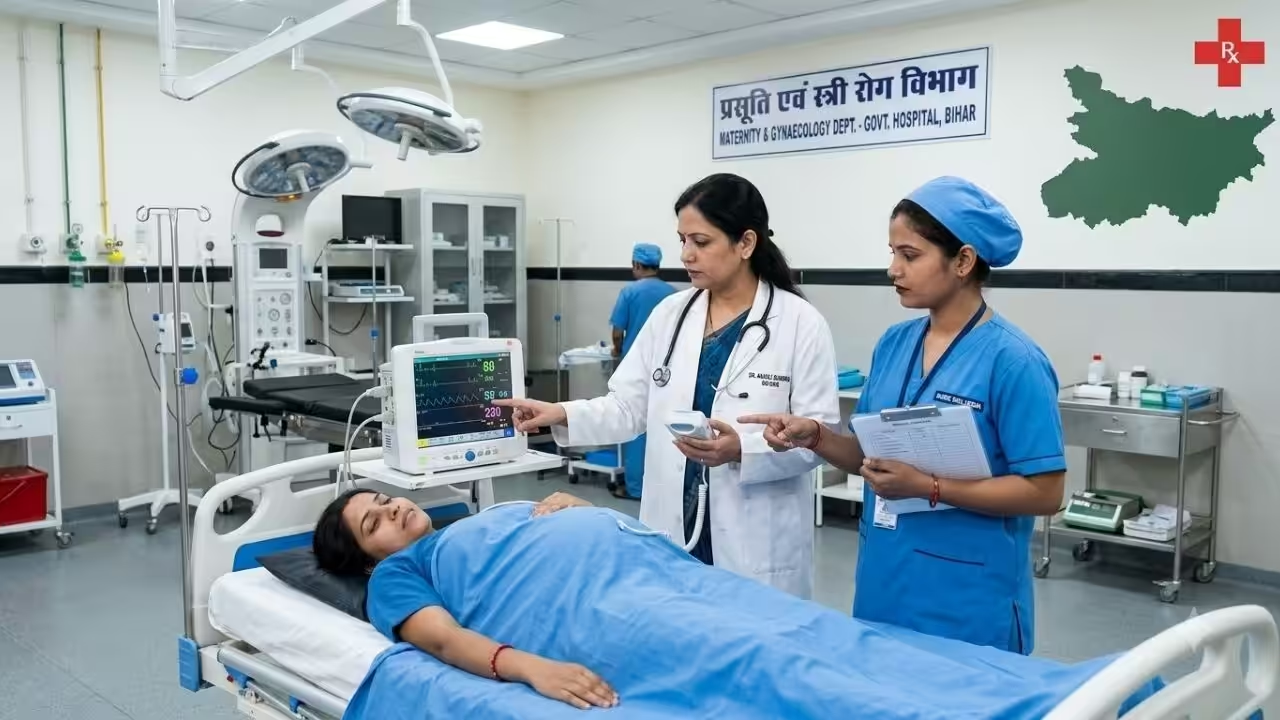
The Bihar government has directed government hospitals across the state to assess shortages of essential equipment used in maternal healthcare, with a particular focus on Obstetrics and Gynaecology (O&G) operation theatres and Labour, Delivery and Recovery (LDR) complexes. The exercise is intended to identify facility-level gaps that may affect safe deliveries, emergency obstetric care and surgical preparedness.
Hospitals have been asked to compare their existing equipment with prescribed healthcare standards and submit requirements for missing or inadequate devices. The exercise could provide the Health Department with a clearer picture of where additional equipment is needed and help prioritise procurement according to actual needs. Information related to medical equipment procurement in Bihar is available on the official Bihar Medical Services and Infrastructure Corporation Limited website.
Table of Contents
Bihar Orders Maternal Care Equipment Gap Assessment

The latest direction requires government health facilities to examine whether their maternity units are adequately equipped to provide the level of care expected from them. The assessment focuses on equipment required during labour, delivery, obstetric surgery, anaesthesia, and emergency management.
Hospitals are expected to identify deficiencies rather than merely report the number of devices currently available. This means facilities must determine whether existing equipment is sufficient and suitable for the services they provide.
| Particular | Details |
|---|---|
| State | Bihar |
| Sector | Government healthcare |
| Main focus | Maternal care equipment |
| Facilities under review | Government hospitals |
| Priority areas | O&G operation theatres and LDR complexes |
| Assessment | Existing equipment versus prescribed requirements |
| Next step | Submission of equipment requirements |
| Procurement agency | BMSICL |
What Government Hospitals Have Been Asked to Do
Hospital authorities have been instructed to review the equipment available in maternity units and identify any devices that are missing or insufficient. The exercise is designed to generate a more accurate list of requirements before procurement decisions are made.

Facilities are expected to:
- Check the equipment currently available in maternity units.
- Assess requirements in O&G operation theatres and LDR complexes.
- Identify missing or inadequate devices.
- Compare availability with applicable standards.
- Submit requirements for equipment that needs to be procured.
Focus on Actual Service Readiness
The key issue is whether a hospital is equipped to manage both routine deliveries and complications. A maternity ward may be operational, but the absence of essential monitoring, anaesthesia or surgical equipment can restrict its ability to handle emergency cases.
Equipment Included in the Assessment
The equipment review covers several devices used in obstetric and maternity care. Reported items include operating tables, anaesthesia workstations, electrical suction machines, flash autoclaves, 12-channel ECG machines, and foetal Doppler units.
Major Equipment and Their Uses
| Equipment | Primary Use |
|---|---|
| Operation table | Obstetric and gynaecological surgical procedures |
| Anaesthesia workstation | Anaesthesia delivery and monitoring during surgery |
| Electrical suction machine | Suction during surgical and emergency procedures |
| Flash autoclave | Rapid sterilisation of instruments |
| 12-channel ECG machine | Monitoring and assessment of cardiac activity |
| Foetal Doppler | Monitoring foetal heart rate |
The final requirement at each hospital may vary depending on the type of facility, the services offered, and the existing equipment.
O&G Operation Theatres Under Special Focus
Obstetrics and Gynaecology operation theatres are critical for managing caesarean sections and other surgical emergencies related to pregnancy and childbirth. Their inclusion in the assessment indicates that the government is examining surgical readiness alongside routine maternity care.
A functional obstetric operation theatre requires more than an operating table. Anaesthesia equipment, suction systems, sterilisation facilities and patient-monitoring devices must work together to support safe surgery.
Why Equipment Gaps Matter
If even one critical component is unavailable, a hospital may be unable to conduct an emergency procedure despite having doctors and other infrastructure in place. Identifying such gaps can therefore help authorities determine which facilities require immediate equipment support.
LDR Complexes Also Being Reviewed
Labour, delivery, and recovery complexes are another major area covered by the assessment. These facilities are designed to support women through labour, childbirth and immediate post-delivery recovery within an integrated clinical setting.
Properly functioning LDR facilities require equipment for maternal monitoring, foetal assessment, emergency intervention and infection control. Any shortage can affect medical teams’ ability to respond quickly when complications arise.
Key Functions Supported by LDR Equipment
Adequate equipment helps maternity teams monitor the condition of both mother and baby, manage complications during labour and stabilise patients when emergency intervention or referral becomes necessary.
The focus on LDR complexes is therefore directly linked to improving the operational readiness of delivery units rather than simply expanding hospital infrastructure.
IPHS-Based Standards Expected to Guide Assessment
The Indian Public Health Standards provide benchmarks for infrastructure, equipment, human resources and service delivery at different levels of public healthcare facilities. Comparing available equipment with these standards can help identify whether hospitals have the resources expected for their category.
The Ministry of Health and Family Welfare provides official information on national public health standards and related programmes.
Why a Standard-Based Review Is Important
A uniform inventory count would not necessarily reveal whether a hospital has adequate equipment for the services it is expected to provide. A standards-based assessment allows authorities to identify specific gaps according to the size and function of each facility.
This approach can also help distinguish between hospitals that have basic maternity infrastructure and those equipped to provide more advanced obstetric or surgical care.
Hospitals to Submit Equipment Requirements
After identifying shortages, government hospitals are expected to submit their requirements through the designated state procurement system. This will allow authorities to consolidate equipment needs and determine where procurement is necessary.
BMSICL plays an important role in procuring medical equipment and healthcare infrastructure for government institutions in Bihar. Current equipment procurement information can be checked through the corporation’s official equipment tender section.
Assessment Does Not Mean Equipment Has Already Been Purchased
The present exercise is primarily an assessment and requirement-identification process. It should not be interpreted as confirmation that all identified equipment has already been sanctioned, procured or delivered.
Procurement would depend on the requirements submitted by hospitals, as well as on administrative approval and subsequent tendering or purchase procedures.
Exercise Could Strengthen Maternal Emergency Care
Identifying equipment shortages could help strengthen hospitals that currently struggle to handle obstetric emergencies. Facilities with adequate equipment may be able to manage more cases locally, particularly when specialist doctors, trained nurses, anaesthesia services and blood availability are also in place.
Improved equipment availability could reduce treatment delays and help ensure that referrals are made when a patient genuinely requires higher-level care, rather than because a basic device is unavailable.
Potential Benefits
The initiative could support:
- Faster management of obstetric emergencies.
- Better preparedness for Caesarean sections.
- Improved maternal and foetal monitoring.
- More effective use of existing hospital infrastructure.
- Reduced dependence on higher-level hospitals for manageable cases.
These benefits will depend on timely procurement, installation, maintenance and availability of trained staff.
LaQshya Programme Provides Relevant Policy Context
The maternal equipment assessment also fits within the broader national focus on improving the quality of care provided during childbirth. The Labour Room Quality Improvement Initiative, or LaQshya, focuses on improving care in labour rooms and maternity operation theatres in public health facilities.
Details of the programme are available on the National Health Mission’s LaQshya page.
Equipment is One Part of Maternity Quality Improvement
Improving maternal care requires functioning equipment, adequate doctors and nurses, medicines, infection-control systems, and emergency protocols. The Bihar exercise specifically addresses the equipment component by identifying where shortages exist at the hospital level.
What Happens Next
The next important development will be the completion of hospital-level assessments and the consolidation of the requirements submitted by different facilities. The results should indicate the scale of equipment shortages and the categories of devices that require priority procurement.
As of August 19, 2026, a comprehensive public report detailing district-wise shortages or the total quantity of equipment proposed for procurement has not been identified.
Key Updates to Watch
Future updates are likely to become more significant once the government releases information on:
- Number of hospitals reporting equipment gaps.
- District-wise requirement of devices.
- Total equipment proposed for procurement.
- Budgetary allocation.
- Tender or procurement orders.
- Supply and installation timelines.
Why the Bihar Maternal Equipment Exercise Matters
The initiative is relevant because the quality of institutional delivery depends not only on bringing pregnant women to hospitals but also on ensuring that those facilities can provide timely treatment. Equipment shortages in labour rooms or obstetric operation theatres can directly affect both emergency preparedness and treatment capacity.
By asking hospitals to identify their actual requirements, Bihar is moving towards a facility-specific assessment that could support more targeted procurement. The effectiveness of the initiative will ultimately depend on how quickly identified gaps are converted into procurement, installation and functional use of equipment across government hospitals.