Bihar’s public healthcare infrastructure serves over 120 million residents through a network of government hospitals, medical colleges, and primary health centers. For students pursuing medical science and their families in Patna and across the state, understanding this system reveals both the clinical training opportunities and the ground realities of healthcare delivery in one of India’s most populous regions.
Table of Contents
Government Medical Colleges and Teaching Hospitals in Patna
Patna Medical College and Hospital (PMCH), established in 1925, remains the oldest and largest medical institution in Bihar. The 1,548-bed facility serves as the primary teaching hospital for undergraduate and postgraduate medical students while handling approximately 3,000 outpatient visits daily. MBBS students here gain exposure to high patient volumes across departments including medicine, surgery, pediatrics, and obstetrics.
Indira Gandhi Institute of Medical Sciences (IGIMS) in Sheikhpura, Patna, functions as the state’s premier super-specialty center. With 750 beds and departments covering cardiology, neurosurgery, nephrology, and oncology, IGIMS provides advanced tertiary care that draws patients from neighboring districts. The institution admits 100 MBBS students annually and offers postgraduate programs across 19 specialties.
Nalanda Medical College in Patna and Darbhanga Medical College serve as additional hubs for medical education. According to National Medical Commission recognized colleges, these institutions collectively train over 1,200 medical students each year, addressing the state’s physician shortage which currently stands at one doctor per 28,000 people compared to the WHO recommendation of one per 1,000.
District Hospitals and Secondary Care Infrastructure
Bihar operates 38 district hospitals, each serving as the referral center for community health centers and primary health centers within their jurisdiction. Patna’s Nalanda Medical College Hospital and Gandhi Maidan-adjacent government hospitals provide secondary care including emergency services, surgical interventions, and maternity care. These facilities typically maintain 200 to 400 beds and employ specialist doctors across core disciplines.
The infrastructure quality varies significantly between districts. Urban centers like Patna, Muzaffarpur, and Bhagalpur have relatively better-equipped facilities with functional operation theaters and diagnostic services. Rural district hospitals often face equipment shortages, irregular power supply, and staffing gaps that limit their operational capacity during peak seasons.
| Facility Type | Number in Bihar | Bed Capacity Range | Primary Function |
|---|---|---|---|
| Medical Colleges | 11 | 500–1,500 | Tertiary care and medical education |
| District Hospitals | 38 | 200–400 | Secondary referral care |
| Sub-Divisional Hospitals | 101 | 30–100 | First referral units |
| Community Health Centers | 533 | 10–30 | Primary care with specialists |
| Primary Health Centers | 1,863 | 4–6 | Basic healthcare and immunization |
Rural Healthcare Delivery Through PHCs and CHCs
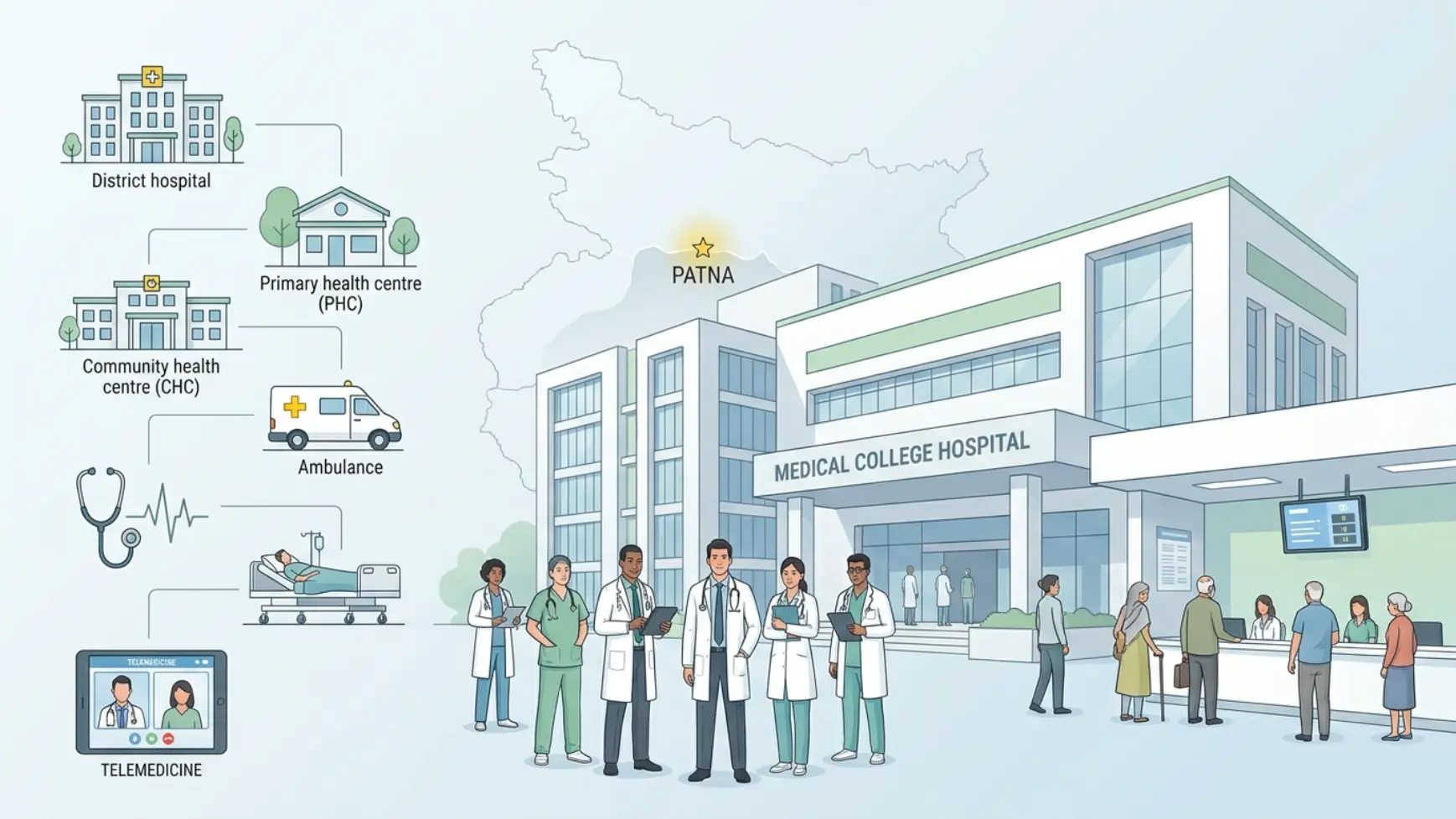
The primary health center network forms the backbone of rural healthcare access in Bihar. With 1,863 PHCs spread across villages and 533 community health centers at block levels, the system theoretically covers most rural populations. Each PHC serves a catchment area of 20,000 to 30,000 people, providing outpatient care, maternal health services, immunization programs, and basic diagnostics.
Community health centers function as 30-bed facilities with four specialist doctors (medicine, surgery, pediatrics, obstetrics-gynecology) and operation theater capabilities. However, vacancy rates for specialist positions frequently exceed 60 percent statewide, forcing patients to travel to district headquarters for procedures that should be available locally.
For medical students considering rural postings or understanding public health challenges, these ground realities offer perspective. Many MBBS graduates fulfill their mandatory rural service requirements at CHCs and PHCs, gaining experience managing diverse cases with limited resources. High school students from rural Bihar pursuing medical careers often draw motivation from observing these infrastructure gaps firsthand.
Government Health Schemes and Patient Access Programs
Bihar participates in the Ayushman Bharat Pradhan Mantri Jan Arogya Yojana, which provides health coverage up to five lakh rupees per family annually for hospitalization expenses. The state’s implementation covers approximately 1.4 crore families, making government hospitals the primary beneficiaries as empaneled facilities. Patients access free diagnostics, medications, and surgical procedures at PMCH, IGIMS, and district hospitals under this scheme.
The Mukhyamantri Kanya Utthan Yojana and other state-specific programs focus on maternal and child health, ensuring institutional deliveries and newborn care at government facilities. According to Bihar National Family Health Survey indicators, institutional delivery rates have climbed from 34 percent in 2005 to 74 percent in recent years, largely due to financial incentives and improved facility deliveries at CHCs and district hospitals.
Parents evaluating healthcare options for families can access these services at minimal or zero cost, though waiting times and facility congestion remain persistent challenges, especially at premier institutions like PMCH where appointment backlogs stretch weeks for specialty consultations.
Challenges Facing Bihar’s Public Healthcare System
Infrastructure deficits persist despite recent expansions. Many PHCs lack functional diagnostic equipment, forcing patients to seek private laboratories for blood tests and imaging. Power outages disrupt operation theaters and cold chain storage for vaccines. Sanitation conditions in older government hospitals like PMCH have drawn public criticism, though ongoing renovation projects aim to address these concerns.
Human resource shortages compound infrastructure gaps. Bihar faces a deficit of over 3,500 doctors and 8,000 nurses across government facilities. Medical students completing their MBBS often prefer postgraduate opportunities or private practice in urban centers rather than rural government positions, perpetuating the cycle. Retention programs offering housing, security, and professional development incentives have shown limited success in reversing this trend.
The doctor-population ratio, patient load per facility, and geographic accessibility create a healthcare environment where public institutions remain overburdened. For students entering medical careers, these systemic challenges represent both obstacles and opportunities to contribute meaningfully to public health improvement.
Future Directions and Infrastructure Expansion Plans
The Bihar government has announced plans to establish four new medical colleges in underserved districts, targeting 600 additional MBBS seats by 2026. Upgradation of 100 PHCs to health and wellness centers under Ayushman Bharat aims to expand service offerings to include screening for non-communicable diseases, geriatric care, and mental health support.
Telemedicine initiatives connecting rural health centers with specialists at PMCH and IGIMS have begun pilot operations in select districts. For high school students considering medical careers, these technological integrations signal evolving practice environments that blend traditional clinical skills with digital health competencies.
The expansion trajectory suggests growing opportunities for medical professionals in Bihar’s public sector, provided systemic reforms address compensation structures, working conditions, and career progression pathways that currently drive talent toward private institutions or migration to other states.