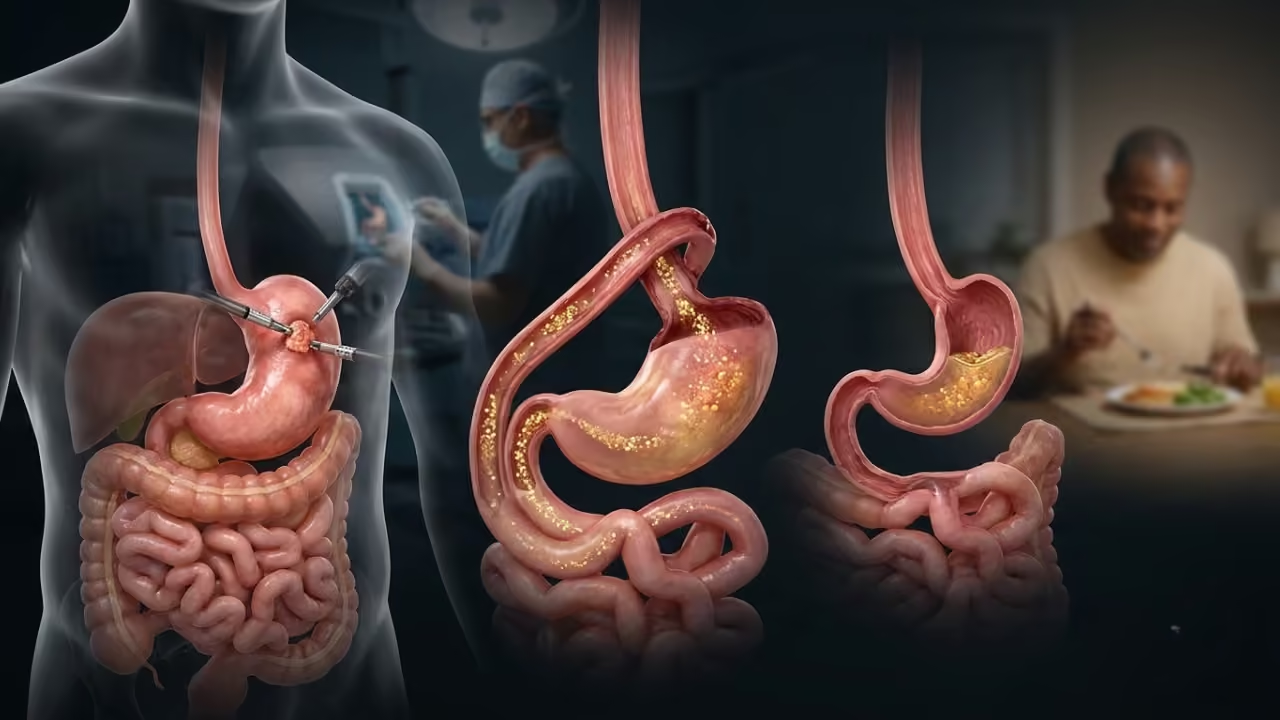
Stomach cancer surgery is increasingly being designed around a second question alongside removing the tumor: how well will the patient be able to eat and live afterward?
Surgeons are revisiting operations that preserve part of the stomach, creating new intestinal reservoirs after complete stomach removal, and using endoscopic or minimally invasive procedures when the cancer allows it.
The shift reflects a broader change in surgical oncology. Cancer control remains the priority, but long-term nutrition, reflux, dumping syndrome and everyday quality of life are receiving greater attention.
In a recent Mayo Clinic overview of changing stomach cancer surgery, surgical oncologist Dr. Travis Grotz described several approaches now being used or refined, including proximal gastrectomy with double-tract reconstruction, jejunal J-pouch reconstruction after total gastrectomy, endoscopic removal of selected early cancers, and minimally invasive surgery.
These techniques are not appropriate for every patient, and none replaces careful cancer staging. But for selected people, they may reduce some of the long-term consequences of conventional stomach removal.
Table of Contents
Why Removing the Stomach Can Change Everyday Life
Surgery remains an important treatment for many localized gastric cancers.
Depending on where the tumor is located and how far it has spread, surgeons may remove:
- part of the stomach;
- the upper portion of the stomach;
- or the entire stomach.
A total gastrectomy can be necessary to remove the cancer safely, but it eliminates the stomach’s normal role as a food reservoir.
Food then passes from the esophagus directly into the small intestine.
Patients may need to eat five or six smaller meals rather than a few conventional meals and may develop problems such as:
- early fullness;
- weight loss;
- nutritional deficiencies;
- reflux;
- dumping syndrome.
Dumping syndrome occurs when food moves into the small intestine too rapidly, sometimes producing abdominal symptoms, diarrhea, weakness, dizziness or palpitations.
Reducing those long-term effects is one reason reconstruction techniques are receiving renewed attention.
Surgeons Are Revisiting Proximal Gastrectomy
For some cancers in the upper part of the stomach, surgeons can remove only the upper section through a procedure called proximal gastrectomy.
The idea is attractive because it preserves part of the stomach.
Historically, however, patients could experience severe reflux when the esophagus was connected directly to the remaining stomach.
That problem led many surgeons, particularly in the United States, to favor total gastrectomy instead.
New reconstruction techniques may make stomach preservation more practical.
Double-Tract Reconstruction Offers Another Route for Food
One option is double-tract reconstruction, or DTR.
After removing the upper portion of the stomach, surgeons reconstruct the digestive tract so that food can travel through the small intestine while some also continues through the remaining stomach.
The aim is to retain useful stomach function without exposing the esophagus to the same degree of reflux associated with simpler reconstructions.
Recent evidence supports the approach.
A 2026 systematic review of reconstruction after proximal gastrectomy examined 32 studies involving 2,958 patients.
The researchers found that direct esophagus-to-stomach reconstruction generally produced the poorest reflux control, while approaches such as double-tract reconstruction offered a more favorable balance between reflux prevention and surgical complications.
Preserving the Stomach May Also Help Nutrition
A separate systematic review found that proximal gastrectomy with double-tract reconstruction can provide nutritional advantages compared with total gastrectomy in selected patients.
Reported benefits included better maintenance of factors such as:
- body weight;
- hemoglobin;
- albumin;
- vitamin B12.
The available evidence nevertheless comes from heterogeneous studies, and patient selection remains critical.
Cancer location and stage determine whether preserving part of the stomach is oncologically appropriate.
A smaller operation should never be chosen if it compromises complete tumor removal.
What Happens When the Whole Stomach Must Be Removed?
Some cancers still require total gastrectomy.
In those cases, surgeons are exploring ways to replace at least part of the stomach’s storage function.
One approach is a jejunal J-pouch.
A section of small intestine is reshaped to create a reservoir that temporarily stores food before releasing it farther into the digestive tract.
Mayo Clinic reports that its patients with a pouch may be able to return to a more conventional eating pattern after recovery, rather than relying indefinitely on numerous small meals.
Evidence Suggests the Pouch Can Reduce Dumping Syndrome
The J-pouch concept is supported by broader clinical evidence.
A systematic review and meta-analysis of 892 patients compared Roux-en-Y reconstruction with and without a jejunal pouch after total gastrectomy.
Dumping syndrome occurred in:
- 13.8% of patients with a J-pouch;
- 26.9% with standard Roux-en-Y reconstruction.
Heartburn was also less frequent:
- 20.4% with a pouch;
- 39.0% without one.
The study found no significant difference in mortality, overall complications or anastomotic leakage, although pouch reconstruction took longer to perform.
This suggests the technique may improve some functional outcomes without creating a clear increase in major surgical risk.
Some Early Stomach Cancers May Avoid Gastrectomy Entirely
Another important development is doing less surgery when it is safe.
Some very early gastric cancers can be removed endoscopically through the mouth rather than through abdominal surgery.
Advanced endoscopic techniques can remove cancers confined to superficial layers of the stomach wall when the risk of lymph-node spread is sufficiently low.
For eligible patients, that can preserve the entire stomach.
The trade-off is that selection must be precise.
If the cancer has meaningful risk of lymph-node involvement, endoscopic treatment alone may not provide adequate cancer control.
Minimally Invasive and Robotic Surgery Are Expanding
When gastrectomy is required, surgeons increasingly use laparoscopic or robot-assisted approaches.
Instead of one large abdominal incision, these operations use smaller ports for cameras and surgical instruments.
Potential benefits can include:
- less postoperative pain;
- smaller incisions;
- faster physical recovery;
- shorter hospitalization.
The essential oncological requirements remain unchanged.
Surgeons must still remove the tumor with appropriate margins and perform adequate lymph-node dissection.
A technically smaller incision does not mean a less comprehensive cancer operation.
Surgery Is Increasingly One Part of a Larger Treatment Plan
For locally advanced stomach cancer, surgery often works alongside systemic treatment.
Depending on the cancer, patients may receive chemotherapy, immunotherapy or targeted drugs before or after the operation.
The treatment sequence is increasingly individualized according to:
- tumor stage;
- tumor biology;
- treatment response;
- overall health.
Mayo Clinic also notes that a very small number of highly selected patients with initially more extensive disease may sometimes be considered for surgery after an exceptional response to systemic treatment.
That should not be interpreted as evidence that surgery routinely cures metastatic gastric cancer.
Quality of Life Is Becoming a Surgical Endpoint
The larger change is philosophical as much as technical.
Historically, the success of stomach cancer surgery was judged primarily by whether the tumor could be removed safely and whether the patient survived.
Those remain essential outcomes.
But as treatment improves, surgeons increasingly consider what happens years after the operation.
Questions now include:
- Can part of the stomach safely remain?
- Can reflux be reduced?
- Can patients maintain weight more easily?
- Can dumping syndrome be minimized?
- Can patients return to more normal meal patterns?
- Can the cancer be removed endoscopically instead?
That represents a move toward function-preserving cancer surgery.
These Newer Approaches Are Not Automatically Better for Everyone
The evidence requires some restraint.
No single reconstruction method has emerged as the best option for every gastric cancer patient.
The 2026 systematic review of proximal gastrectomy techniques found considerable variation among studies, and the authors concluded that reconstruction decisions should remain individualized.
Similarly, creating a J-pouch adds operative complexity and is not required in every total gastrectomy.
The best operation depends on:
- exact tumor location;
- stage;
- lymph-node risk;
- patient anatomy;
- nutritional status;
- surgeon experience;
- available institutional expertise.
What the Latest Developments Really Mean
The new surgical approaches do not represent a single breakthrough that suddenly makes stomach cancer surgery easy.
Instead, they show how the field is evolving.
For some upper-stomach cancers, surgeons may preserve part of the stomach using better reconstruction techniques.
When total gastrectomy is unavoidable, a J-pouch may help recreate some reservoir function and reduce problems such as dumping syndrome.
For carefully selected early cancers, endoscopic removal may avoid gastrectomy altogether.
And minimally invasive surgery can reduce the physical burden of operations that still need to be performed.
The common objective is simple but important:
remove the cancer effectively while preserving as much normal digestion, nutrition and everyday life as oncologically possible.