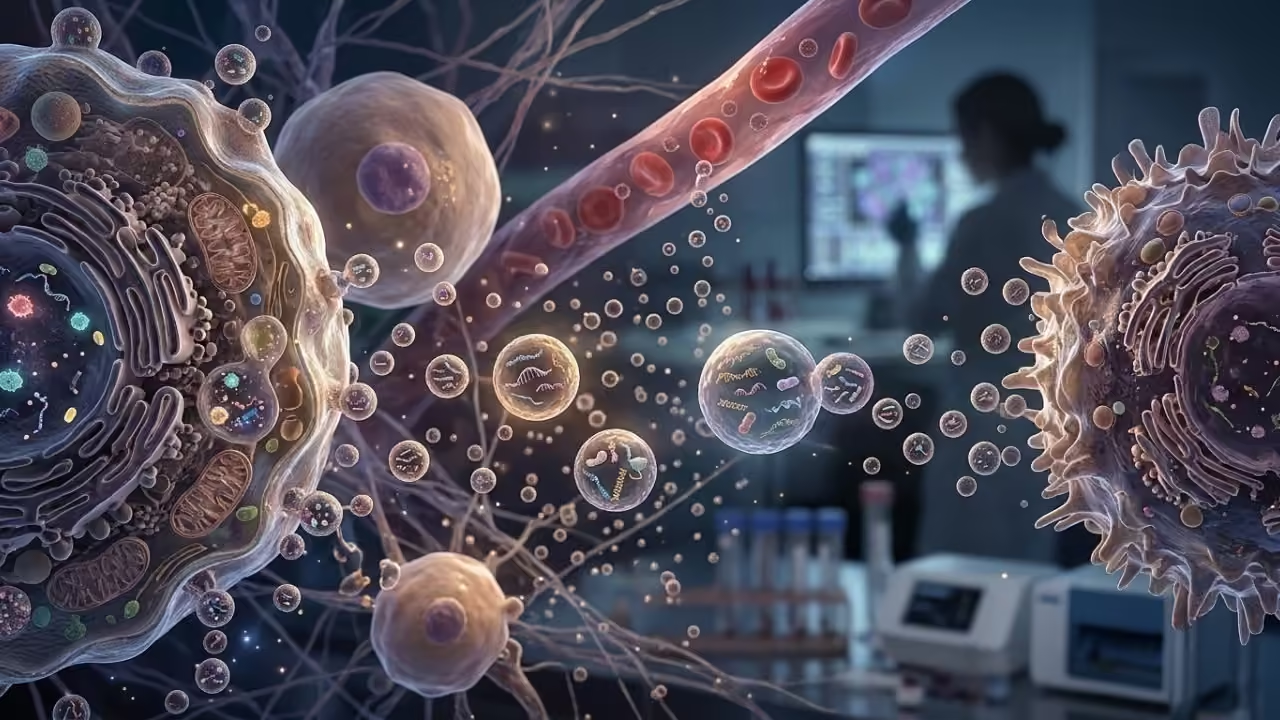
Tiny packages released by cells may help scientists understand an important biological connection between aging and cancer.
Known as extracellular vesicles, or EVs, these membrane-bound particles travel between cells carrying proteins, fats, RNA, DNA fragments and other molecular cargo. Under healthy conditions, they support normal communication between tissues. But during aging, cellular stress and cancer, both the number of vesicles released and the messages they carry can change substantially.
A review published in Oncoscience brings together evidence showing that extracellular vesicles released by aging and cancer cells share several molecular characteristics, particularly signals linked to inflammation, stress responses, tissue remodeling and altered cellular communication.
The similarities do not mean extracellular vesicles are a single cause of either cancer or aging. Instead, researchers believe they may represent one of the communication systems through which age-related cellular changes influence surrounding tissues, potentially creating conditions that can also support tumor development and progression.
Table of Contents
What Are Extracellular Vesicles?
Cells constantly communicate with one another.
Some messages are transmitted through hormones or direct contact. Others travel inside tiny membrane-bound particles released into the space surrounding cells.
These particles are broadly known as extracellular vesicles.
Major categories include:
- exosomes;
- microvesicles;
- apoptotic bodies.
Different EV types are produced through different cellular mechanisms and can vary greatly in size and biological function.
Their cargo may contain:
- proteins;
- lipids;
- microRNAs;
- messenger RNA;
- DNA fragments;
- metabolites.
When another cell absorbs a vesicle, those molecules can alter the recipient cell’s behavior.
In effect, extracellular vesicles act as microscopic biological delivery systems.
Exosomes Are Among the Best-Studied EVs
The new review focuses particularly on exosomes, a widely studied class of extracellular vesicles.
Exosomes are especially interesting because they can be detected in body fluids including:
- blood;
- urine;
- saliva.
Their contents can reflect what is happening inside the cells that produced them.
This creates two major areas of scientific interest.
First, exosomes may actively contribute to disease by carrying biological signals from one cell to another.
Second, their molecular cargo might eventually provide biomarkers revealing the presence or progression of disease.
Aging Changes Cellular Communication
As tissues age, increasing numbers of cells can enter a state known as cellular senescence.
Senescent cells have permanently stopped dividing but remain metabolically active.
Instead of quietly disappearing, they can release large quantities of inflammatory molecules, growth factors and enzymes.
This mixture is known as the senescence-associated secretory phenotype, or SASP.
Researchers increasingly recognize extracellular vesicles as another component of this age-related communication system.
Senescent cells can release EVs carrying altered combinations of:
- microRNAs;
- inflammatory signals;
- proteins;
- mitochondrial material;
- DNA fragments.
Those vesicles can influence nearby cells and may contribute to age-related changes extending beyond the original senescent cell.
Senescence Signals May Spread Through Tissues
One concern is that EVs from senescent cells may help propagate dysfunctional signaling.
For example, vesicle cargo may influence neighboring cells by altering:
- inflammatory pathways;
- mitochondrial function;
- gene expression;
- extracellular matrix remodeling;
- stress responses.
This raises the possibility that cellular aging may be partly amplified through intercellular communication.
A single damaged or senescent cell would therefore not necessarily act in isolation.
It could potentially influence surrounding cells through the molecules it releases.
But EVs May Also Protect Aging Cells
The biology is more complicated than saying extracellular vesicles accelerate aging.
Cells can also use EVs as a way to dispose of unwanted or damaged material.
Some experimental evidence discussed in the review suggests that preventing vesicle release can actually intensify certain features of cellular senescence.
That means EV secretion may sometimes serve a protective function by removing harmful intracellular material.
The same system can therefore have contrasting effects:
EVs may help individual cells maintain internal balance while also spreading inflammatory or stress-related signals through surrounding tissue.
Which effect dominates likely depends on the cell type, cargo and biological context.
Cancer Cells Use the Same Communication System
Tumor cells also release large quantities of extracellular vesicles.
But their cargo can be very different.
Cancer-derived EVs may contain molecules capable of supporting:
- tumor growth;
- angiogenesis;
- immune evasion;
- invasion;
- metastasis;
- resistance to treatment.
A major 2026 review in Nature Reviews Cancer describes extracellular vesicles and related particles as important messengers through which tumors influence tissues throughout the body.
Cancer therefore behaves not only as a collection of malignant cells but as a system capable of sending molecular instructions to other organs.
Tumor EVs Can Help Cancer Escape the Immune System
One important function involves immune suppression.
Tumor-derived extracellular vesicles can carry proteins and regulatory molecules capable of changing how immune cells behave.
Some cancer EVs have been found to carry immune-regulatory molecules such as PD-L1.
PD-L1 can suppress the activity of T cells, which would otherwise help attack malignant cells.
If vesicles carrying immunosuppressive molecules circulate through the tumor environment or bloodstream, they could potentially weaken anti-cancer immune responses beyond the original tumor cell.
Extracellular Vesicles May Prepare Distant Organs for Metastasis
Cancer-associated vesicles may also travel to organs far from the original tumor.
There, they can influence:
- immune cells;
- blood vessels;
- stromal cells;
- metabolism;
- extracellular matrix.
Researchers describe this process as helping create a pre-metastatic niche.
A pre-metastatic niche is a tissue environment that becomes more favorable for cancer cells before metastatic cells actually arrive.
The Nature Reviews Cancer analysis describes tumor-derived extracellular vesicles as important contributors to this long-distance communication.
That means metastasis may begin biologically before cancer cells physically colonize a new organ.
Aging and Cancer EVs Share Several Signals
This is where the new Oncoscience review becomes particularly interesting.
Extracellular vesicles released by senescent cells and cancer cells can carry overlapping categories of cargo.
These include:
- inflammatory molecules;
- stress-response proteins;
- regulatory RNAs;
- mitochondrial components;
- DNA fragments;
- extracellular-matrix-modifying proteins.
Both aging cells and tumor cells can also increase EV release under stressful conditions such as:
- oxidative stress;
- DNA damage;
- hypoxia;
- inflammation.
Researchers believe these similarities may reveal common stress-response pathways operating in aging tissues and tumors.
Aging Is the Biggest Risk Factor for Many Cancers
Cancer becomes dramatically more common with increasing age.
Part of that relationship can be explained by mutations accumulating over time.
But aging also changes the environment surrounding cells.
Older tissues often contain more:
- senescent cells;
- chronic inflammation;
- altered immune activity;
- extracellular matrix changes;
- metabolic dysfunction.
Extracellular vesicles could potentially help connect these processes by carrying molecular information between cells.
This does not mean aging EVs directly transform healthy cells into cancer cells.
The hypothesis is subtler.
Age-related vesicle signaling may help create a tissue environment in which damaged or abnormal cells have a greater opportunity to survive and expand.
Chronic Inflammation Could Be One Important Bridge
One of the strongest overlapping themes is inflammation.
Low-grade chronic inflammation commonly increases with age, a phenomenon sometimes called inflammaging.
Senescent cells can contribute to this state.
Cancer cells can also exploit inflammatory pathways to support:
- growth;
- blood-vessel formation;
- invasion;
- immune suppression.
If extracellular vesicles help transmit inflammatory signals between cells, they could become one of several mechanisms connecting age-related inflammation with cancer biology.
Again, this is a mechanistic framework rather than proof that EVs alone explain why cancer becomes more common with age.
EV Cargo Could Become a Source of Cancer Biomarkers
Because extracellular vesicles circulate in blood and other body fluids, scientists are studying whether their contents can reveal disease without needing a conventional tissue biopsy.
A tumor may release vesicles containing:
- cancer-specific mutations;
- abnormal RNAs;
- characteristic proteins;
- altered lipids.
Detecting those signals could potentially help with:
- early cancer detection;
- monitoring treatment;
- detecting recurrence;
- tracking disease progression.
This concept is sometimes described as an EV-based liquid biopsy.
The appeal is clear: a blood or urine sample would generally be much easier to obtain repeatedly than a tumor biopsy.
Aging Biomarkers May Also Be Possible
A similar idea is being explored in aging biology.
If senescent and aging tissues release distinctive EV cargo, researchers may eventually be able to measure biological aging through circulating vesicles.
Potential signals could involve:
- senescence-related microRNAs;
- inflammatory proteins;
- mitochondrial components;
- stress-response molecules.
Such markers could theoretically help distinguish chronological age from biological tissue aging.
However, no universal EV-based “aging test” is currently established for routine clinical use.
The Biggest Problem Is Separating the Signals
One technical challenge is that nearly every tissue releases extracellular vesicles.
A blood sample therefore contains a complex mixture originating from:
- immune cells;
- blood vessels;
- liver;
- muscles;
- other organs;
- tumors, when present.
Researchers need ways to determine which vesicle came from which tissue.
This can be difficult.
A cancer-specific signal may represent only a tiny fraction of the total extracellular-vesicle population circulating in blood.
EV Classification Is Still Complicated
The field also faces basic technical challenges.
Extracellular vesicles vary enormously in:
- size;
- cellular origin;
- formation mechanism;
- molecular cargo.
Different laboratories may use different techniques to isolate them.
Those methods can produce vesicle populations with different levels of purity.
That makes it harder to compare results across studies.
Improved standards for isolation, measurement and classification remain essential before many EV-based diagnostics can become routine.
Extracellular Vesicles Could Also Deliver Treatments
Scientists are interested in using EVs not only as biomarkers but also as therapeutic delivery systems.
Cells naturally use vesicles to transport biological molecules.
Researchers are therefore investigating whether engineered EVs could carry therapeutic cargo such as:
- RNA;
- proteins;
- gene-regulating molecules;
- drugs.
A 2026 review of extracellular-vesicle targeting and uptake describes substantial interest in exploiting the natural delivery properties of these particles for therapy.
Engineered EVs could potentially help drugs reach particular tissues while protecting fragile biological molecules from degradation.
Could Scientists Block Harmful Cancer EVs?
Another strategy is to interfere with vesicles rather than use them for delivery.
Researchers are investigating whether therapies could:
- reduce tumor EV production;
- block EV release;
- prevent uptake by target cells;
- neutralize harmful EV cargo.
If tumor-derived vesicles contribute significantly to immune suppression or metastasis, disrupting those communication pathways could potentially slow disease.
But this approach remains experimentally challenging because healthy cells also rely on EV communication.
Broadly blocking extracellular vesicles could therefore have unintended effects.
What About ‘Anti-Aging’ Exosome Treatments?
Commercial interest in exosome-based anti-aging products has grown rapidly.
The scientific evidence is far more preliminary.
Research is exploring whether EVs from young, stem-like or regenerative cells can influence:
- inflammation;
- mitochondrial function;
- tissue repair;
- cellular senescence.
Most of these findings remain preclinical.
The Oncoscience review does not show that commercially available exosome therapy can reverse human aging.
Claims that exosomes currently provide proven rejuvenation treatments therefore go well beyond the evidence summarized in the paper.
EVs Are Not Automatically Good or Bad
One of the most important conclusions from the research is that extracellular vesicles cannot be assigned one universal biological role.
Their effects depend on:
- the cell releasing them;
- the conditions affecting that cell;
- the molecular cargo;
- the tissue receiving the vesicle.
An EV released by a healthy cell involved in tissue repair may have beneficial effects.
A vesicle released by a senescent cell may amplify inflammation.
A tumor-derived vesicle may suppress immunity or prepare distant tissue for metastasis.
The same basic communication system can therefore support both normal physiology and disease.
The Review Does Not Report a New Treatment
This distinction is important for interpreting the research.
The new paper is a scientific review.
It synthesizes existing studies rather than reporting a new clinical trial.
It does not demonstrate:
- a new cancer therapy;
- an anti-aging treatment;
- a diagnostic blood test;
- a way to prevent cancer by blocking EVs.
Its contribution is conceptual.
It brings aging and cancer research together and highlights overlapping patterns in extracellular-vesicle signaling.
Why the Review Matters
Scientists have traditionally studied aging and cancer as partly separate fields.
But cancer incidence rises sharply with age, suggesting that some biological mechanisms may overlap.
Extracellular vesicles provide one plausible point of connection.
Both aging and cancer alter the messages cells send.
Both involve cellular stress.
Both can involve inflammation and changes in tissue architecture.
By studying the cargo of vesicles released under these conditions, researchers may gain a better picture of how cells reshape their environments during aging and disease.
What the Research Really Shows
Extracellular vesicles are not simply cellular waste.
They are active molecular messengers.
In aging tissues, they can transport signals associated with senescence, inflammation and tissue remodeling.
In cancer, they can carry molecules involved in immune suppression, metastasis, angiogenesis and treatment resistance.
The overlap between these systems may help explain part of the biological relationship between aging and increased cancer vulnerability.
But extracellular vesicles are only one part of a much larger network.
They do not provide a single explanation for aging or cancer.
For researchers, their greatest value may be precisely that complexity: these tiny packages preserve a molecular record of what cells are experiencing, and can carry those experiences to cells elsewhere in the body.