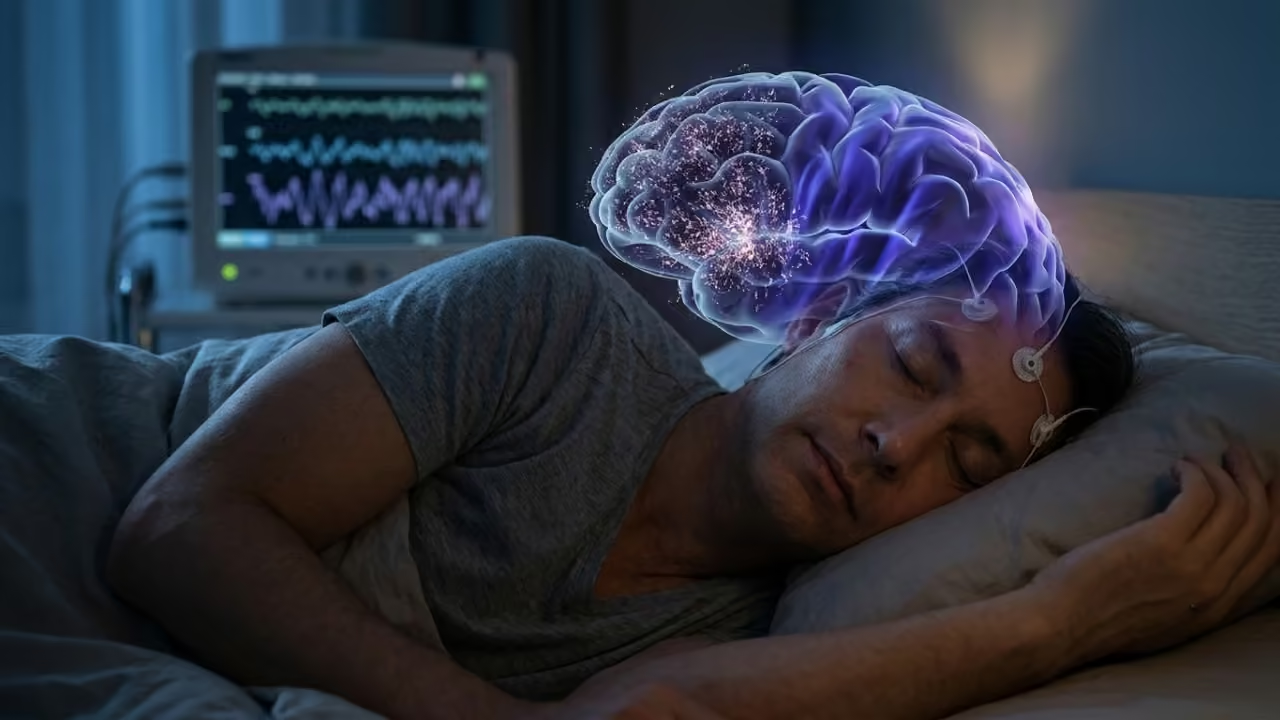
For millions of people living with tinnitus, nighttime can create a frustrating paradox. The quiet makes the ringing, buzzing or hissing harder to ignore, yet one of the body’s most fundamental processes, deep sleep, may also temporarily suppress some of the abnormal brain activity associated with the condition.
A growing body of neuroscience research suggests that tinnitus and sleep are closely intertwined.

Scientists at the University of Oxford have proposed that tinnitus-related brain activity may interfere with normal sleep, while the powerful synchronized brain waves of deep non-REM sleep may temporarily overpower or dampen some of the neural activity linked to the phantom sound.
The idea was outlined in an Oxford-led review published in Brain Communications, and subsequent animal and human studies have added experimental support.
The findings do not mean that simply sleeping longer will cure tinnitus. But they suggest that understanding, and perhaps eventually manipulating, the interaction between sleep and abnormal auditory activity could open a new direction for treatment.
Table of Contents
What Exactly Is Tinnitus?

Tinnitus is the perception of sound when there is no corresponding external sound source.
People may describe it as:
- ringing;
- buzzing;
- humming;
- whistling;
- clicking;
- hissing.
The sound may occur in one ear, both ears or seem to originate somewhere inside the head.
Tinnitus is often associated with hearing loss or damage to the auditory system, including damage from prolonged loud-noise exposure.
But researchers increasingly view persistent tinnitus as more than an ear problem.
Changes in the brain appear to help maintain the phantom perception after the original auditory injury has occurred.
The Brain May Compensate for Lost Sound
One leading explanation involves changes in neural gain.
When the brain receives less information from the ear because of hearing damage, auditory circuits may compensate by increasing their sensitivity.
That can involve increases in:
- spontaneous neural firing;
- synchronized activity;
- neuronal excitability;
- communication between auditory and non-auditory brain networks.
This increased activity may contribute to the perception of sound even when no external sound exists.
In persistent tinnitus, altered activity can extend beyond the auditory cortex into areas involved in attention, emotion and arousal.
That helps explain why the condition can affect far more than hearing.
Sleep and Tinnitus May Compete for Control of Brain Activity
The Oxford researchers noticed an intriguing biological conflict.
Tinnitus is associated with areas of abnormally elevated or synchronized brain activity.
Deep sleep, by contrast, produces powerful slow-wave activity across large parts of the cortex.
During deep non-REM sleep, neurons become highly synchronized and alternate between periods of activity and silence.
These slow waves are among the defining features of restorative sleep.
Researchers proposed that the strong global synchronization occurring during deep sleep could temporarily override or disrupt the more localized abnormal activity associated with tinnitus.
The basic idea is:
tinnitus promotes local hyperactivity → deep sleep promotes global slow-wave synchronization → slow waves may temporarily suppress tinnitus-related activity
That mechanism remains under investigation, but later experiments have begun to support it.
Animal Research Found Sleep-State Changes in Tinnitus Activity
Oxford researchers later tested the sleep-tinnitus relationship experimentally using ferrets.
The animals were exposed to noise in one ear under controlled conditions, producing hearing changes associated with tinnitus.
Researchers then studied their behavior, sleep and auditory-cortex activity.
Ferrets showing stronger behavioral evidence consistent with tinnitus also developed:
- disrupted sleep;
- stronger auditory cortical responses;
- altered neural activity.
Importantly, some of that exaggerated cortical activity became weaker during non-REM sleep.
This provided experimental evidence that tinnitus-related neural hyperactivity can change according to sleep state.
The animal study was small, however, and tinnitus cannot be measured subjectively in animals in the same way it can in humans.
Human EEG Studies Point to Persistent Hyperarousal
Human research has since produced findings consistent with the same general model.
Studies using electroencephalography, or EEG, have found that people with tinnitus can show signs of persistent cortical hyperarousal during both waking and sleeping states.
Instead of fully transitioning toward the slower synchronized brain rhythms typical of restorative sleep, parts of the brain may retain unusually high-frequency activity.
This may help explain why tinnitus and sleep problems frequently occur together.
People with tinnitus often report:
- difficulty falling asleep;
- frequent awakenings;
- poorer sleep quality;
- difficulty returning to sleep after waking.
The relationship may operate in both directions.
Tinnitus can interfere with sleep, while poor sleep may make tinnitus more noticeable or distressing the following day.
Why Deep Sleep Is Different
Sleep is not one uniform state.
Humans cycle through several stages during the night.
Deep non-REM sleep is characterized by particularly strong slow-wave activity.
During this stage:
- cortical neurons become highly synchronized;
- responsiveness to external sensory input decreases;
- arousal thresholds increase;
- large parts of the brain enter repeating active and inactive phases.
The Oxford researchers proposed that this global pattern could interfere with the abnormal firing patterns responsible for tinnitus perception.
In simple terms, the brain’s deep-sleep rhythms may temporarily become stronger than the tinnitus network.
Does the Ringing Actually Disappear During Deep Sleep?
That remains difficult to prove directly.
A sleeping person cannot continuously report whether they still consciously perceive tinnitus.
Researchers can measure:
- brain electrical activity;
- auditory-cortex responses;
- sleep stages;
- neural synchrony.
Those studies show that tinnitus-associated neural activity changes during sleep.
Some patients also report reduced tinnitus following sleep or describe periods in which the condition seems less intrusive.
But scientists cannot yet conclude that tinnitus universally “switches off” during deep sleep.
The more accurate statement is that deep sleep may suppress some neural activity associated with tinnitus.
Tinnitus May Also Prevent the Brain From Reaching Stable Deep Sleep
The relationship appears to work in the opposite direction as well.
If tinnitus-related neural activity remains active while the rest of the brain attempts to transition into sleep, it could act like a persistent internal source of arousal.
Unlike traffic noise or a barking dog, the sound originates within the nervous system itself.
Researchers have therefore proposed that tinnitus may behave somewhat like an internal sensory signal capable of interrupting the normal transition into stable sleep.
That could produce a cycle:
tinnitus-related hyperarousal → disrupted sleep → reduced restorative sleep → greater tinnitus distress
Breaking that cycle could become clinically important.
Quiet Bedrooms Can Make Tinnitus Feel Louder
There is also a simpler perceptual reason tinnitus often becomes troublesome at night.
During the day, the brain receives constant external sound:
- conversation;
- traffic;
- music;
- appliances;
- workplace noise.
These sounds can partially mask tinnitus.
A quiet bedroom removes much of that competing stimulation.
The tinnitus itself may not actually become louder, but it becomes more noticeable because there is less external sound competing for attention.
This is one reason sound enrichment can help some patients at bedtime.
Could Improving Sleep Reduce Tinnitus?
Possibly, but this is not yet established as a tinnitus treatment.
If slow-wave sleep suppresses tinnitus-related activity, researchers could eventually investigate ways of strengthening or stabilizing deep sleep.
Potential research directions include:
- improving insomnia treatment;
- behavioral sleep interventions;
- carefully designed sound stimulation during sleep;
- neuromodulation;
- interventions that increase slow-wave sleep.
The Oxford researchers have specifically suggested that manipulating local or global slow-wave activity could eventually provide a new avenue for tinnitus research.
But no established therapy currently cures tinnitus by increasing deep sleep.
Better Sleep May Still Help With Tinnitus Distress
Even without directly eliminating the phantom sound, treating sleep problems may still improve quality of life.
Poor sleep can worsen:
- mood;
- anxiety;
- concentration;
- emotional regulation;
- tolerance of chronic symptoms.
Improving sleep could therefore reduce how intrusive tinnitus feels, even if the underlying neural signal remains.
This distinction is important.
Reducing tinnitus distress is not necessarily the same thing as reducing the neural generator of tinnitus itself.
Current Treatments Focus on Managing the Condition
The updated 2026 clinical guideline from the American Academy of Otolaryngology–Head and Neck Surgery emphasizes personalized management for adults with persistent, bothersome tinnitus.
Current evidence-supported approaches include:
- comprehensive hearing evaluation;
- cognitive behavioral therapy;
- hearing aids when hearing loss is present;
- sound enrichment;
- cochlear implant evaluation in eligible patients;
- selected use of bimodal neuromodulation.
The guideline recommends against routinely using medications or dietary supplements specifically to treat persistent tinnitus.
It also identifies the relationship between sleep quality, sleep apnea and tinnitus severity as an important area requiring further research.
Cognitive Behavioral Therapy Remains One of the Strongest Options
Cognitive behavioral therapy, or CBT, does not necessarily eliminate the phantom sound.
Instead, it helps people change how they respond emotionally and behaviorally to tinnitus.
For many patients, this can reduce:
- distress;
- anxiety;
- sleep disruption;
- attention focused on tinnitus.
Because sleep and tinnitus distress interact so closely, CBT-based approaches can sometimes improve both.
Hearing Evaluation Is Important
Tinnitus is frequently associated with hearing loss.
The updated clinical guideline recommends comprehensive audiological assessment for people with tinnitus.
Treating underlying hearing problems can sometimes make tinnitus less noticeable.
Hearing aids, for example, increase access to external sound and may reduce the contrast between tinnitus and the surrounding acoustic environment.
Not Every Case of Tinnitus Is the Same
Tinnitus is better viewed as a symptom with multiple possible causes rather than one single disease.
It may occur after:
- noise-induced hearing damage;
- age-related hearing loss;
- ear disorders;
- head or neck injury;
- certain medications;
- other neurological or auditory-system changes.
Some forms can also change with movements of the jaw, head or neck.
Because the underlying mechanisms differ, the most effective treatment may vary substantially between individuals.
Some Tinnitus Symptoms Need Medical Evaluation
Most tinnitus is not caused by a dangerous condition.
However, certain features deserve medical assessment.
These include:
- tinnitus in only one ear;
- pulsatile tinnitus that follows the heartbeat;
- sudden hearing loss;
- asymmetric hearing loss;
- neurological symptoms.
The 2026 clinical guideline recommends targeted evaluation rather than routine brain imaging for everyone with tinnitus.
Why the Sleep Connection Could Still Be Important
The major significance of the emerging research is conceptual.
Tinnitus has often been approached mainly as a hearing problem.
But the sleep research reinforces the idea that persistent tinnitus involves wider brain-state regulation.
The same networks controlling:
- arousal;
- sensory awareness;
- attention;
- cortical synchronization
may influence how strongly tinnitus is perceived.
Understanding that interaction could eventually allow researchers to target the neural state in which tinnitus occurs rather than only the auditory damage that originally triggered it.
What the Research Really Shows
Scientists have not discovered a way to switch tinnitus off by putting someone into deep sleep.
But several lines of evidence now point toward a meaningful relationship.
Tinnitus is associated with persistent neural hyperarousal.
That hyperactivity may interfere with sleep.
During deep non-REM sleep, powerful slow-wave brain activity may in turn temporarily suppress some of the abnormal neural activity associated with tinnitus.
That creates an intriguing possibility:
the brain may already possess a natural state capable of partially quieting the mechanisms behind the phantom sound.
The challenge now is determining whether scientists can safely harness that state while people are awake, or improve sleep in ways that produce meaningful, lasting reductions in tinnitus.