Medical students in Patna encounter a healthcare delivery system built on three interconnected tiers: Primary Health Centres (PHCs), District Hospitals, and Medical Colleges. Understanding how these institutions interact shapes clinical training expectations and career pathways across Bihar’s medical landscape.
Table of Contents
The Three-Tier Structure of Public Healthcare
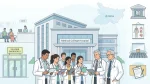
India’s public health system operates through a hierarchical model designed to distribute care efficiently across urban and rural populations. Primary Health Centres serve as the first point of contact, typically covering populations of 20,000 to 30,000 in rural areas. These facilities handle basic outpatient services, immunizations, maternal care, and minor procedures. Each PHC connects upward to a Community Health Centre, which in turn refers complex cases to District Hospitals.

District Hospitals function as secondary care facilities, equipped with specialist departments including surgery, obstetrics, pediatrics, and internal medicine. Patna’s district healthcare network includes Nalanda Sadar Hospital and Patna Sadar Hospital, where medical students often complete rural postings. When a case exceeds district-level capacity, referral protocols direct patients to tertiary care institutions.
Medical Colleges as Tertiary Care Anchors
Patna Medical College Hospital and the All India Institute of Medical Sciences Patna represent the apex of this system. These teaching hospitals deliver specialized interventions unavailable at lower tiers: organ transplants, advanced cardiac procedures, oncology treatment, and neurosurgery. For MBBS students, these institutions serve dual purposes—they are both training grounds and the final safety net for Bihar’s most critically ill patients.
According to state-wise number of beds, the state maintains specific bed-to-population ratios that determine when district facilities must transfer patients upward. Third-year students rotating through medicine and surgery departments witness this referral chain firsthand, learning triage principles that balance resource constraints against patient needs.
Clinical Training Across All Three Levels
MBBS curricula mandate exposure to each tier. First-year students typically observe outpatient departments at medical college hospitals before progressing to community medicine postings at PHCs during second year. These rural rotations, often in districts surrounding Patna, teach students to diagnose without advanced imaging, manage limited drug formularies, and coordinate referrals when complications arise.
| Institution Type | Typical Services | Staff Profile | Student Exposure |
|---|---|---|---|
| Primary Health Centre | OPD, immunization, maternal care, basic diagnostics | Medical Officers, ANMs, pharmacists | Community medicine postings, preventive care focus |
| District Hospital | Emergency care, surgery, specialist OPDs, inpatient wards | Specialists, residents, nursing staff | Internship rotations, secondary care protocols |
| Medical College Hospital | Tertiary procedures, ICU, super-specialties, research | Faculty, senior residents, PG students | Core clinical years, bedside teaching, complex case management |
Referral Protocols and System Strain
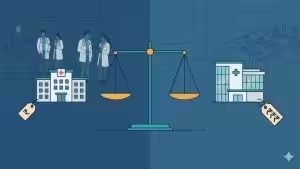
The system functions optimally when each tier handles cases appropriate to its capacity. Reality often diverges from theory. PHCs lacking functional X-ray machines refer patients upward prematurely. District hospitals with vacant specialist positions cannot retain cases meant for secondary care. This compression pushes excessive patient loads onto tertiary centers, where medical students encounter overcrowded wards and rushed teaching rounds.
Parents evaluating medical education quality should recognize that exposure to this strained system builds clinical judgment under resource scarcity. Students who master diagnostic reasoning at a PHC with limited labs often outperform peers trained exclusively in well-equipped urban hospitals when they enter independent practice.
Career Implications Beyond Graduation

Understanding this hierarchy influences post-MBBS decisions. Students aiming for rural medical officer positions will spend careers managing PHC-level care. Those pursuing MD or MS degrees return to medical college hospitals as residents, eventually staffing district hospitals as specialists or joining teaching faculty. Each tier offers distinct professional challenges—primary care demands breadth and resourcefulness, while tertiary care requires depth in narrower specialties.
Graduates from Patna increasingly staff Bihar’s expanding network of district hospitals, where government incentives now attract specialists to underserved regions. The system’s structure, once viewed as a constraint during training, becomes the framework within which most medical careers unfold across the state.